
What if the hotel reservation is ready, but the booth schedule has changed? Trade show hotel booking is more than securing rooms. It means coordinating event dates, accommodation and each traveller’s plans before the team sets off.
If you’re coordinating several people, you may not have every traveller’s details at once. Reservation terms and change procedures can also be hard to track across emails and spreadsheets. A clear sequence helps keep decisions, responsibilities and booking details organised.
This guide sets out a practical workflow: confirm event and booth requirements, gather traveller information, match accommodation to the schedule, then record reservation terms and change procedures. It also explains how flexible payment options may fit into event cash flow. Kemet International provides tailored exhibitor hotel packages, with AI-driven travel tools to support accommodation planning and reservation tracking. Installments and Book Now, Pay Later reservations are additional options to consider once the booking requirements are clear.
Key Takeaways
- Align accommodation planning with the event schedule and exhibitor responsibilities, not just arrival and departure dates.
- Use a defined trade show hotel booking sequence to clarify requirements, booking responsibility and the details needed for each reservation.
- Compare hotel options against venue access, the planned transport approach, reservation conditions and your team’s needs.
- Maintain one shared reservation record so the team can track booking references, status changes and amendments.
- Explore tailored exhibitor hotel packages and flexible payment options as part of the accommodation plan.
Trade show hotel booking starts with the event plan
Trade show hotel booking means matching accommodation to an exhibitor team’s event dates, work duties and individual travel needs. Start with the schedule, not a room search. A trade show can involve exhibiting, demonstrations and other scheduled activities, so the accommodation plan needs to reflect what each traveller must do and when.
An exhibitor stay differs from a routine business trip. The team may need to be present for booth setup before the event opens, cover scheduled duties during show hours and remain through breakdown. Booking only around the public event dates can miss these operational requirements.
What should an exhibitor confirm before searching?
Build a shared event brief before comparing accommodation. Separate fixed details from items still pending, such as the final staffing list or an individual’s arrival time. This lets the team plan ahead without treating estimates as confirmed information.
- Record event dates, venue access periods, booth setup and breakdown duties, and expected departure timing.
- List known travellers, their event roles and any different arrival or departure dates.
- Mark each detail as confirmed or pending, and assign someone to update it when plans change.
- Set one accommodation planning owner and decide how updates will be shared with travellers and decision-makers.
For example, if booth setup begins before the main event schedule, note it as a separate requirement rather than assuming everyone arrives on the first public day. If staffing is not final, mark the expected team size as provisional and identify who will provide the confirmed list.
How does accommodation support the event schedule?
Map each person’s stay to their actual responsibilities. A team member supporting setup may need to arrive earlier than a colleague whose duties begin later. Someone assigned to breakdown may need a later departure. Different stay dates can make sense when roles differ, so don’t let a shared itinerary obscure those distinctions.
Allow a practical buffer around work commitments. Arrival timing should give each traveller time to be ready for assigned setup duties, while departure timing should account for scheduled breakdown or other event work. The right buffer depends on the confirmed schedule and the traveller’s arrangements. Record the reasoning instead of assuming one pattern will suit everyone.
Keep the accommodation plan focused on where the team will stay and for which dates. It does not replace event registration or separate arrangements for reaching the event. Treating these as distinct workstreams clarifies responsibilities while keeping accommodation decisions tied to the operational plan.
How to complete trade show hotel booking in a clear sequence
A reliable booking process takes the team from shared requirements to a verified reservation record. This keeps decisions traceable and helps prevent provisional information from being mistaken for confirmed booking details.
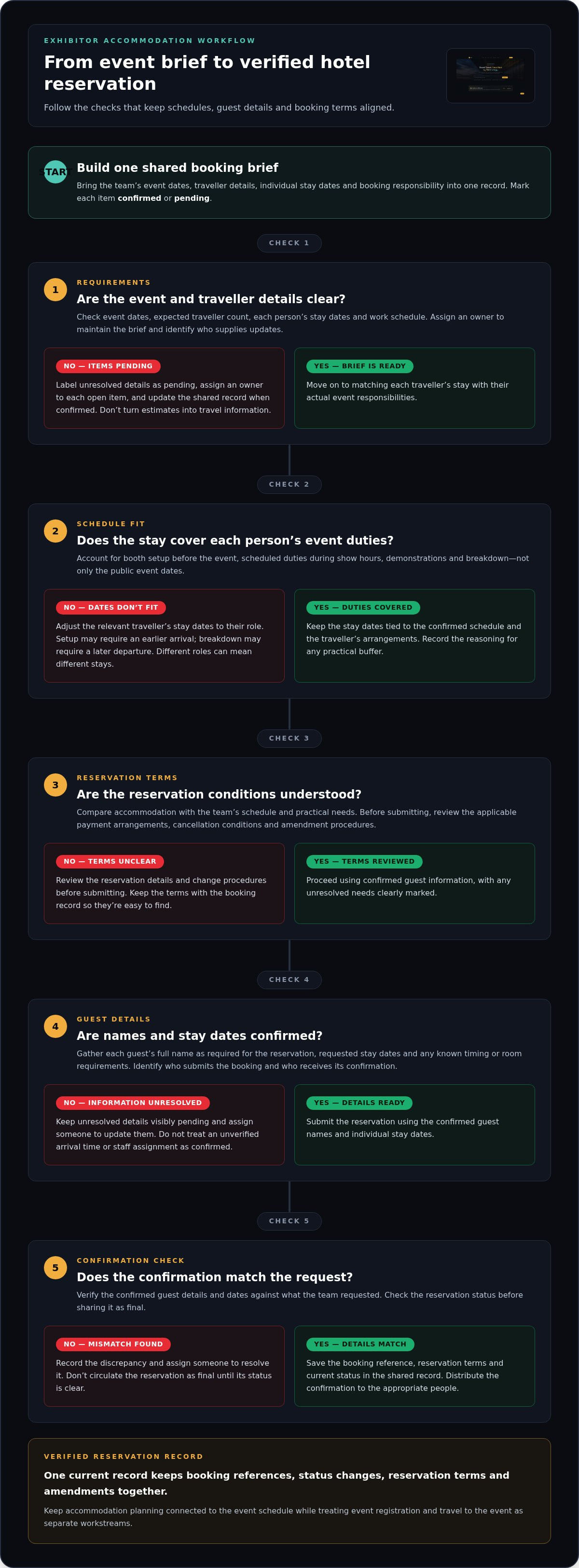
The trade show hotel booking sequence is to consolidate requirements, assess suitable options, review reservation terms, submit accurate guest details and record the confirmed reservation.
How should the booking brief be prepared?
Create one shared record for event dates, expected traveller count, individual stay dates and known work schedules. Assign an owner to maintain the record, submit reservation details and distribute confirmations. Make clear who supplies updates and where the current version is stored, so everyone works from the same information.
Separate confirmed details from pending decisions. For example, list an approved event date as confirmed, but mark an undecided staff assignment or unverified arrival time as pending. Assign an owner to each open item and, where useful, set a target date for resolving it. This keeps planning moving without turning an assumption into travel information.
- Gather each guest’s full name as required for the reservation, along with their requested stay dates.
- Record who is responsible for submitting the booking and who will receive its confirmation.
- Note known timing or room requirements, and label unresolved needs clearly.
What should happen between selecting and confirming a reservation?
Once an option is selected, compare its reservation details with the brief before submitting. Check each traveller’s name and stay dates, then read the applicable terms, including payment arrangements, cancellation conditions and amendment procedures. Keep the terms with the booking record so the person managing changes can find them without searching through scattered messages.
After submission, verify the confirmation separately. Check that the guest details and dates match what the team requested. If they differ, record the discrepancy and assign someone to resolve it. Don’t circulate the reservation as final until its status is clear.
- Consolidate requirements. Assemble event dates, traveller names, individual stay dates and booking responsibility in one brief.
- Assess options. Compare accommodation against the team’s schedule and practical needs.
- Review terms. Understand the reservation conditions and how changes are handled.
- Submit details. Use confirmed guest information, keeping unresolved items visibly pending.
- Verify and record. Match the confirmation to the request, then save its reference, terms and current status.
Maintain one designated record as the source of truth, updating it when an outstanding detail is resolved or a reservation changes. Teams planning accommodation through tailored exhibitor hotel packages can follow the same sequence to keep requirements and reservation information organised.
Compare hotel options and booking terms against exhibitor needs
Compare accommodation against the team’s event plan rather than relying on a single headline feature. A useful trade show hotel booking comparison considers stay dates, the venue schedule, practical access and the conditions attached to each reservation. Record the same details for every option to make trade-offs easier to see.
| Factor | What to compare |
|---|---|
| Stay dates | Whether the available dates cover each traveller’s setup, event and breakdown duties. |
| Location relevance | How the property’s position relates to the venue schedule and the team’s actual transport plan. |
| Access needs | Whether arrival and departure arrangements work with planned event commitments. |
| Reservation conditions | Cancellation, amendment, payment and guest-detail requirements stated for the booking. |
| Team fit | Whether the accommodation arrangement matches the group’s room requirements and differing stay lengths. |
Use the table to compare like with like. If one option appears closer to the venue, weigh that against how the team will travel and when staff must be present. Proximity alone does not show whether an option fits the schedule. The transport plan and booth duty times provide the relevant context.
Which accommodation factors matter for an exhibitor team?
Start with each traveller’s daily responsibilities. Someone assigned to early setup may need different arrival timing from a colleague whose duties begin later. Check whether the option can accommodate separate stay dates, without assuming who will share a room or how long each person will stay. Describe room requirements in practical terms based on the team’s needs, not presumed property features.
Then consider the full work sequence. If a traveller is scheduled to support breakdown, compare the departure date with that commitment. If the team has different arrival dates, check whether the reservation can reflect them. This helps reveal whether one arrangement suits everyone or whether the plan needs separate reservations.
How should reservation terms be compared?
Read the specific terms that apply to each option. Review when cancellations or amendments are permitted, what payment conditions apply, and how guest details must be provided or changed. Don’t assume two rates follow the same rules, even when the accommodation options otherwise look similar. Keep the relevant terms with your comparison so the decision reflects the actual conditions.
Flexibility and commitment involve different operational trade-offs. More flexible conditions may leave room to respond to staffing changes, while stricter conditions may require the team to settle details earlier. Neither is automatically better. Consider how likely the relevant details are to change and whether the team can meet the stated conditions.
The reservation’s own terms are the authoritative reference for its conditions. For a broader framework for assessing package components, read the exhibitor hotel packages buying guide. Use your comparison to select an arrangement that fits the event plan, then keep the applicable terms with the booking record.
Keep trade show hotel reservations controlled as plans change
Event details can shift after accommodation is reserved. A revised work schedule, staffing change or different arrival plan may affect one traveller’s stay without changing everyone else’s. A shared reservation record gives the team a reliable view of what is booked, what has changed and who is responsible for the next action.
What reservation details should the team keep together?
Maintain one accessible record for each reservation. Keep the confirmation reference, guest names, stay dates, current status and applicable reservation conditions together. Record who owns the booking and who can update the team record. Clear ownership reduces the risk of conflicting edits or decisions based on an outdated message.
Use consistent status labels, such as “pending,” “confirmed,” “amendment requested” and “updated.” These distinguish a proposed plan from a confirmed reservation. Include the date of the latest update and the person who made it, so readers can tell which information is current.
- Store the confirmation reference alongside the correct guest names and stay dates.
- Keep the relevant cancellation and amendment conditions with the reservation details.
- Limit editing responsibility to designated coordinators, while making current information accessible to the people who need it.
- Use the same status terms across the team and update them when the reservation state changes.
How can a team respond when event plans change?
Start by comparing the revised schedule with the existing stay dates and the reservation’s specific conditions. Identify which travellers are affected, what dates may need to change and whether the terms describe an amendment process. Don’t assume an event update changes a hotel reservation automatically. Treat the reservation update as a separate task and record its status until resolved.
Assign one person to coordinate the accommodation amendment. That owner should follow the applicable reservation instructions, document the outcome and share updated details with the relevant travellers and travel coordinator. If the change is still being processed, label it as pending rather than replacing the confirmed details too soon.
A dated change log adds accountability. For each update, capture the date, affected traveller or reservation, change requested, action owner and current outcome. For example, if a staff member’s departure date moves, record the new date as a request until the reservation reflects it. This helps prevent old instructions from being mistaken for the current plan.
Keep accommodation updates distinct from event registration, booth arrangements and other travel tasks. A schedule change may affect several workstreams, but each needs its own owner and record. This separation makes it easier to see which actions are complete and which still need attention.
For additional support with accommodation planning and reservation tracking, see Kemet’s exhibitor accommodation support.
Complete your trade show hotel booking with a coordinated accommodation partner
A completed trade show hotel booking should reflect the team’s confirmed event requirements, not just a selected room. Finalize traveller details and stay dates, compare reservation conditions, submit the booking, then maintain a shared record of the confirmation and any later changes. This sequence gives the team a consistent reference point as the event approaches.
Accommodation is one part of event operations. Connect its planning to booth duties and the team’s schedule, while managing other travel tasks separately. Kemet International provides tailored exhibitor hotel packages for trade show exhibitors and corporate event teams, with accommodation planned around documented dates and traveller needs.
How can exhibitors structure accommodation support around their event?
Start with the requirements assembled for the team: who is travelling, when each person needs to stay and how their event responsibilities affect those dates. This gives accommodation planning a clear operational basis. A tailored hotel package can support the team’s hotel needs without assuming every traveller follows the same schedule or requires the same stay length.
Keep the scope clear. The accommodation plan covers hotel reservations and their associated details. Event registration, booth arrangements and other travel tasks remain distinct workstreams, each with its own information and owner. Once the booking is made, keep its confirmation and applicable conditions in the team’s shared record so the accommodation plan stays aligned with current event requirements.
When can flexible hotel payment options fit the booking process?
Consider payment structure after the team has defined its booking requirements and reviewed the reservation conditions. Installments and Book Now, Pay Later reservations are payment approaches available for hotel reservations. Depending on the team’s event budget and payment planning, these options may help organise when accommodation payments fit into the wider cash-flow plan.
Treat payment flexibility as one factor in the decision, alongside stay dates, reservation terms and the team’s ability to manage the booking. Don’t assume a particular payment schedule, approval or saving. Review the terms presented for the reservation to understand how the option applies. Record the relevant payment information with the confirmation so the person managing the event budget can refer to the same booking details.
Before completing the process, confirm that the reservation reflects the team’s approved requirements and that someone is responsible for maintaining its record. Kemet’s AI travel technology supports accommodation planning and reservation management, while flexible hotel payment approaches can form part of the booking plan. For event-focused hotel accommodation support, explore Kemet’s exhibitor hotel packages and consider how they fit your team’s documented needs.
Set a stronger foundation for your next event
Use this trade show hotel booking process as a repeatable planning framework. After the event, note which accommodation decisions matched the team’s schedule and where changes created extra coordination. Those observations can inform the next event brief, helping your team start with clearer assumptions and refine its planning over time.
Kemet International supports exhibitor accommodation planning with tailored hotel packages for trade show exhibitors and corporate event teams. Installments and Book Now, Pay Later reservations offer additional approaches to planning hotel payments, while proprietary AI travel technology supports accommodation planning and reservation tracking.
Choose the next step that fits your team’s requirements. Explore Kemet’s exhibitor hotel booking support to consider accommodation options for your event. With a defined planning process and suitable support, your team can move into its next event with greater clarity.
Frequently Asked Questions
Can I book a hotel before every exhibitor’s schedule is final?
In many cases, yes, if the event dates and core accommodation requirements are established. Start planning, but label tentative names, arrival times and staffing assignments as provisional. Before committing, read the reservation’s amendment and cancellation terms. A pending schedule may not be changeable on the conditions you expect. For example, you can compare options while staffing is unresolved, then submit guest details once the team has approved them.
Does a trade show hotel booking include event registration?
No. A hotel reservation covers accommodation under its own terms; it doesn’t register an exhibitor or provide event access. Keep the hotel confirmation separate from registration records and exhibitor credentials. For example, an accommodation coordinator can track each guest’s stay, while the person responsible for event access manages registration and credentials. This separation makes it easier to see which arrangements are complete without treating a hotel confirmation as proof of event participation.
Can one hotel reservation cover team members arriving on different dates?
It depends on the reservation structure and its terms. Some arrangements may accommodate different stay dates, while others may require separate reservations. Before submitting, map each traveller to their arrival and departure dates, then ensure the booking record connects each guest to the correct confirmation. For example, if one exhibitor arrives for preparation before colleagues, record that person’s earlier stay distinctly rather than assuming the whole team shares one itinerary.
Is a flexible hotel reservation always the best choice for a trade show?
No. Flexibility may be useful if staffing or event timing is unsettled, while a reservation with stricter conditions may suit a plan that is already firm. Compare the specific cancellation, amendment and payment terms with the likelihood of changes. For example, if a team member’s participation is still being decided, pay close attention to the relevant change conditions. The best fit depends on the team’s level of certainty and the reservation terms.
What happens if a trade show date changes after I book a hotel?
The reservation’s terms determine whether dates can be amended, which deadlines apply and whether charges may arise. Compare the revised event schedule with the booked stay, then follow the stated amendment process. Keep the existing confirmation on record until the change appears in an updated reservation. Notify affected travellers and the accommodation coordinator of the revised status so they don’t rely on an outdated itinerary.
Can a hotel booking provide access to the exhibition floor?
No. A hotel booking concerns a guest’s accommodation; it doesn’t replace event registration, exhibitor credentials or booth arrangements. Keep these records distinct and assign responsibility for each. For example, a traveller may have a confirmed hotel stay while their event credential is still being processed. Tracking the two statuses separately helps prevent assumptions about access and shows which event arrangements still need attention.
Should I book accommodation for an event team in one payment?
Not necessarily. The right arrangement depends on the reservation setup, each traveller’s dates and the company’s payment process. A coordinated booking may simplify oversight, while separate reservations can reflect different schedules. Kemet offers installments and Book Now, Pay Later options for hotel reservations. These approaches may help teams plan accommodation payments alongside event cash flow. Review the applicable reservation terms and align them with your internal accounting process.


