
The hotel that looks closest to ISE 2027 may not be the most practical choice for your team. The event runs from 2 to 5 February at the exhibition venue, and a booking that doesn’t match the event schedule or access needs can complicate the trip. To avoid exhibition hotel booking mistakes, treat accommodation as part of your event plan, not as a separate travel task.
It’s easy to focus on the nightly rate or choose dates that seem convenient. But unclear cancellation terms, mismatched arrival and departure dates, or scattered team reservations can create avoidable uncertainty.
This guide explains how to align hotel dates with ISE’s schedule, assess travel time to the venue, understand booking terms before committing, and keep team reservations organised. It also looks at how tailored exhibitor hotel packages, flexible payment options and accommodation management technology can support a coordinated booking process. The aim is to make accommodation decisions with the event requirements and your team’s needs in view.
Key Takeaways
- To avoid exhibition hotel booking mistakes, assess how your team will travel between accommodation and the venue rather than relying on map distance alone.
- Compare the full booking conditions, including cancellation windows and prepayment requirements, before choosing a rate.
- Track each traveller’s name, stay dates and room details against individual confirmation records to identify gaps early.
- Use a coordinated booking approach to bring event requirements and team accommodation needs into alignment.
- Tailored exhibitor hotel packages can help structure accommodation planning around the demands of a trade show.
Avoid exhibition hotel booking mistakes by planning around the event
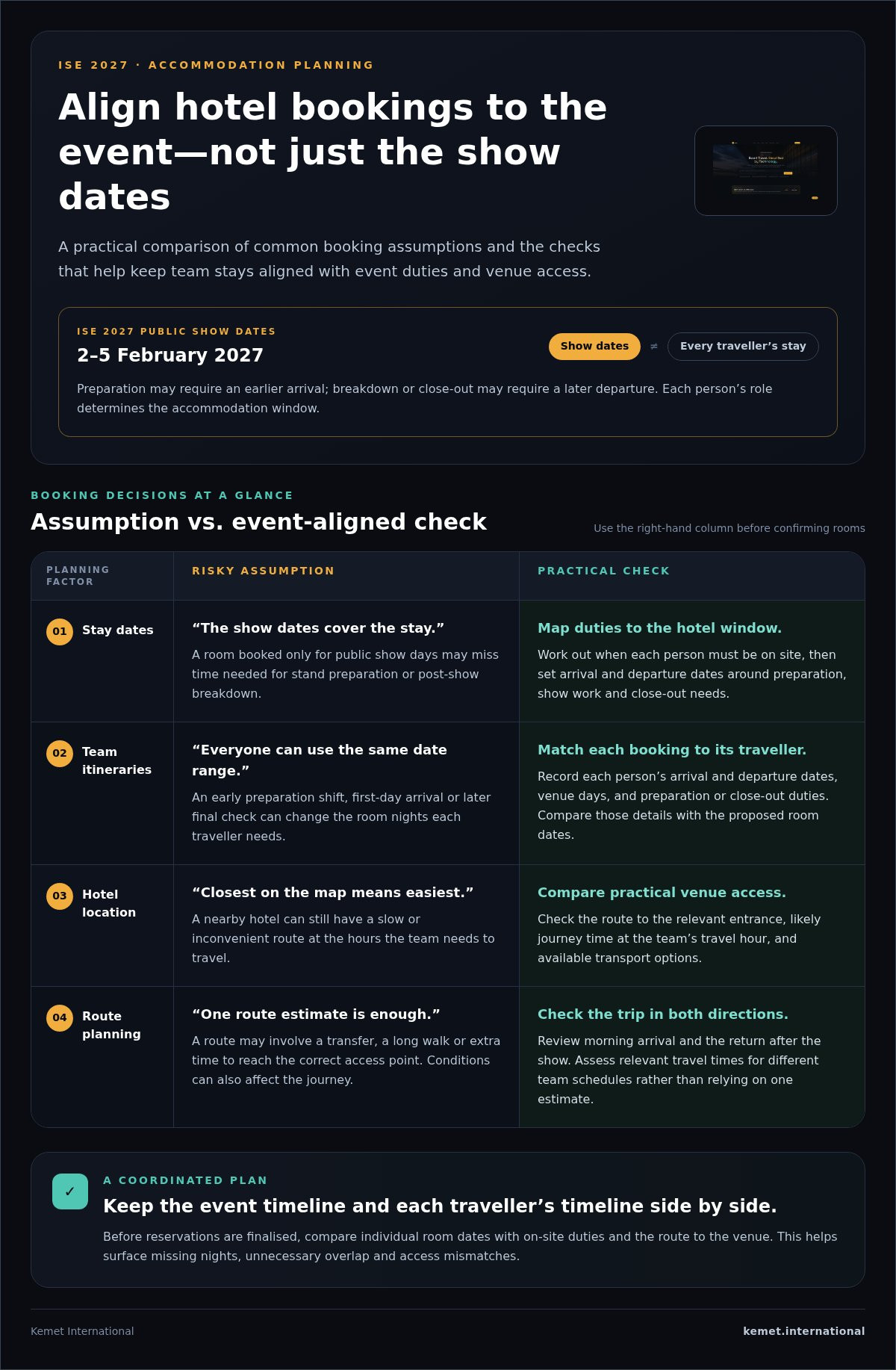
Accommodation planning for a fixed exhibition can feel compressed: event dates are set, team members have different responsibilities, and room details need to align with the work on site. Treating the trip like a flexible leisure stay can leave gaps between the hotel reservation and the actual schedule. A room booked only for the public show days, for example, may not cover an early arrival for preparation or a later departure after dismantling.
An exhibition booking mistake is a preventable mismatch between a hotel reservation and the event or traveller schedule it is meant to support. A reliable plan starts by viewing accommodation as part of the operational timeline. Exhibitions involve more than visitor hours; exhibition planning and logistics can include preparation and coordination that shape when staff need to be present.
Myth: hotel dates only need to cover the exhibition days
ISE 2027 is scheduled for 2-5 February 2027, but those dates don’t automatically define every exhibitor’s hotel stay. Some team members may need to arrive before the opening day for stand preparation, equipment checks or briefings. Others may remain after the final show day to support breakdown or complete close-out tasks. The relevant dates depend on each person’s role and responsibilities.
Map the event schedule alongside venue access requirements, travel plans and hotel check-in and checkout dates. Identify when each team member must be on site, then work backwards to determine a practical arrival date. Account for travel time between accommodation and the venue, too. This joined-up view helps reveal a missing night before reservations are finalised.
Keep the event schedule separate from individual travel schedules. The exhibition has one set of operating dates; each traveller may have a different arrival, departure or on-site commitment. Use both timelines to define the accommodation window rather than applying the show dates uniformly to every booking.
Mistake: assuming every traveller has the same itinerary
A team may share a booth but not a travel plan. One colleague could arrive early to oversee preparation, while another joins on the first show day. A team member responsible for final checks may also need to leave later than colleagues. These differences affect the number of room nights required and can make a single standard date range inaccurate.
Before booking, collect each traveller’s event-related schedule in one place. Record expected arrival and departure dates, the days they need to be at the venue, and any preparation or close-out duties. Compare those details against the proposed room dates, then record each reservation against the correct person. This makes missing nights and unnecessary overlap easier to spot.
For a structured approach to matching accommodation with exhibitor requirements, see the practical guide to exhibitor hotel packages. Tailored packages can help bring event dates and team needs into one accommodation plan.
Myth: any hotel near the exhibition venue is a practical choice
A short distance on a map can look like an easy solution. For an exhibition team, though, location is only useful if the route works with the event schedule and the way people need to move during the day. A nearby hotel may involve a slow or inconvenient journey at peak arrival times, while accommodation farther away may offer a more straightforward transport connection.
Geographic proximity measures distance; reliable event-day access measures how predictably your team can reach the venue when it needs to. To avoid exhibition hotel booking mistakes, compare practical access, not just the hotel’s position on a map. Consider the route to the relevant entrance, likely journey time at the team’s arrival hour, available transport options and the exhibition’s operating schedule.
How to assess hotel access for exhibition days
Start with the team’s actual arrival point at the venue, not simply the venue’s general address. Check the route from the hotel to that entrance and estimate door-to-venue travel time for the hours your team expects to travel. A route that appears direct may still require a transfer, a long walk or extra time to reach the correct access point.
Account for event-day conditions. Traffic patterns, busy transport services or changes to available routes can affect a journey. Review the planned route for both morning arrival and the return after the show. If different team members travel at different times, assess the journey against each relevant schedule rather than relying on a single average estimate.
Why team needs can change what counts as convenient
Convenience depends on the work. A team member attending a standard show day may have different needs from someone responsible for an early start, a late finish or transporting event materials. A longer route may be manageable for one traveller but add friction for someone carrying equipment or needing to reach the venue before general access hours.
Map location against daily movement: hotel to venue, venue to any planned work-related stops, then back to the hotel. Consider whether the team can travel together or will need separate arrangements. These details help determine whether one shared location works or whether differing responsibilities call for a more tailored accommodation plan.
Before booking, compare shortlisted hotels using the same practical criteria: route, expected travel time at relevant hours, transport options and fit with team duties. Record assumptions, such as a journey being walkable or a particular connection operating when needed, so they can be reviewed before reservations are made. This gives the team a consistent basis for weighing location rather than defaulting to the closest pin.
Tailored exhibitor hotel packages can bring accommodation planning into closer alignment with event requirements and team movement. For a booking approach shaped around exhibition travel, explore tailored exhibitor hotel packages.
Myth: the lowest hotel rate is always the safest booking
A low headline rate can look straightforward, but it doesn’t show the full commitment attached to a room. For an exhibition team, the useful comparison is between the complete booking conditions and the likelihood that plans may change. A rate with strict cancellation terms may create more exposure if a team member’s schedule shifts; a flexible option may have different conditions. Neither is automatically right for every booking.
To avoid exhibition hotel booking mistakes, compare what each rate requires and permits. Review cancellation and change deadlines, prepayment timing, and any additional charges that affect the total amount due. Check whether the terms apply to the entire reservation or to individual rooms, especially when a booking covers several team members. The booking’s own terms govern what happens after a change or cancellation.
What the rate conditions actually tell an exhibitor
Refundable terms generally allow cancellation within stated conditions; partly refundable terms may return only a portion or apply limits; non-refundable terms generally restrict refunds after booking. These labels are only a starting point. The specific deadline, permitted changes and consequences in the reservation terms determine the actual commitment.
For an event team, a deadline matters because plans can remain unsettled as the exhibition approaches. Compare the last date to cancel or amend with the point at which your team expects its schedule to be stable. Don’t assume that a change is allowed simply because the booking can’t be cancelled.
| Rate condition | What to review | Planning consideration |
|---|---|---|
| Refundable | Cancellation deadline and refund conditions | Note when flexibility ends. |
| Partly refundable | What portion or components may be retained | Identify the commitment if plans change. |
| Non-refundable | Restrictions on cancellation and amendments | Match the commitment to a settled itinerary. |
Use the comparison alongside the team’s room dates and responsibilities. A reservation that seems suitable for one traveller may create a different level of risk when several rooms are involved. Keep a record of the selected conditions with the booking confirmation so the organiser can refer to the same terms if an adjustment becomes necessary.
How payment timing affects event travel planning
A room reservation and its payment schedule are related, but they’re not the same thing. The reservation terms describe the booking commitment; the payment schedule sets out when payment is due. Review both before confirming, including any required prepayment and the consequences of a late change or cancellation.
Installments or Book Now, Pay Later options for hotel reservations can support event cash-flow planning by structuring payment timing. They don’t remove the need to understand cancellation conditions or other booking terms. Keep payment dates, reservation deadlines and event planning milestones visible together, so the team can manage cash flow without losing track of its obligations.
Compare options on a like-for-like basis: room details, dates, cancellation and amendment rules, payment timing, and additional charges. A clear record makes the decision easier to explain and manage across the event team.
Myth: one confirmation message means the whole team is covered
A confirmation for one room confirms one reservation, not the accommodation status of every traveller. Team bookings may involve separate names, dates or room details, so a message that appears complete can still leave a colleague without a recorded reservation or with incorrect stay dates. The risk is a gap between the team’s agreed plan and the individual bookings in place.
To avoid exhibition hotel booking mistakes, track each reservation at traveller level. A shared team reference should show who is covered, for which dates and under which confirmation. This gives the organiser a clear view of outstanding details without treating one booking record as proof that the full group is set.
A simple sequence for reviewing team reservations
Use the same short review sequence for each traveller. Match the reservation against the agreed event itinerary, then verify the room details and confirmation record. Keep the reference in an accessible location so the booking owner and relevant team members can see the current status.
- Match the traveller’s name to the itinerary and reservation record.
- Compare arrival and departure dates with that person’s agreed schedule.
- Check the room occupancy and confirm the reservation status for each traveller or booking.
- Record the confirmation details and mark any unresolved item for follow-up.
Keep the records specific. If one booking covers more than one traveller, identify who is included rather than assuming the reservation covers everyone in the group. For a broader review of event accommodation details, use the event hotel booking checklist alongside this team-level confirmation process.
How to reduce confusion when plans change
Assign one clear owner to maintain the accommodation reference and coordinate updates. Team members can report changes, but a single record keeper helps prevent different versions of the booking status from circulating. Record every adjustment against the affected traveller and reservation, including what changed and when, rather than relying on memory or an informal message thread.
After an event or travel-plan adjustment, review the affected reservation again. Check whether the stay dates, room details and confirmation records still match the new itinerary. Revisit the booking’s terms where a change or cancellation may affect the reservation. Updating only the team schedule is not enough if the accommodation record remains unchanged.
A concise shared record can include the traveller’s name, stay dates, room occupancy, reservation status, confirmation reference and latest change. Limit access to the people who need to coordinate the trip, and make the current version easy to identify. That structure makes it easier to spot an uncovered traveller before the team depends on the booking.
For coordinated accommodation planning, explore tailored exhibitor hotel packages designed around exhibitor and team requirements.
Prevent exhibition hotel booking mistakes with a coordinated booking approach
The common thread behind exhibition hotel booking mistakes is a disconnect: accommodation is chosen without aligning it to the event schedule, team responsibilities, access needs and booking conditions. A coordinated approach brings these decisions together. It gives organisers a consistent basis for planning while keeping each traveller’s requirements visible.
Start with the operational plan. Establish when the team needs to be on site, which accommodation dates support those commitments, how travellers will reach the venue, and what each reservation permits if plans change. Then compare options against those requirements rather than treating the room rate or hotel location as a decision in isolation. This does not remove the need to review individual confirmations; it gives those checks a shared framework.
When a tailored exhibitor hotel package can help
Exhibitors and corporate teams coordinating accommodation around a trade show may benefit from a package tailored to their event requirements. It can bring hotel planning into one approach shaped around the team’s stay and participation needs, instead of leaving each traveller to make disconnected arrangements. The practical value is matching accommodation decisions to the event plan and keeping them manageable for the organiser.
Payment timing also forms part of planning. Installments and Book Now, Pay Later reservations can support event travel cash-flow planning by offering different ways to structure payment for hotel reservations. They don’t replace a review of the reservation’s dates, cancellation conditions or payment obligations. Treat the payment option as one element of the decision, alongside the accommodation requirements.
How technology supports clearer accommodation management
Kemet International’s proprietary AI travel technology is designed for accommodation management. It supports a more streamlined booking journey, while the organiser’s review remains important to ensure reservations align with the team’s intended arrangements. Technology can support the process; clear requirements and accurate reservation information remain central to coordinating an event stay.
A practical working model is to bring the event schedule and team needs into the accommodation plan, use reservation details to maintain a clear view of arrangements, and review changes against the relevant booking. This helps keep the process structured as plans develop. It also makes it easier to see how dates, room requirements and payment choices relate to one another without assuming that a single decision resolves every team member’s needs.
If you’re planning accommodation for a trade show, explore Kemet International’s exhibitor accommodation support to bring hotel planning, flexible payment options and accommodation management technology into the same conversation.
Make your next exhibition booking a coordinated decision
Before reservations are made, turn your event requirements into a shared accommodation plan. Set out who needs a room, the dates each person needs to stay, and who will maintain the booking record. That gives your team a clear starting point for decisions and a reference to return to if plans change.
A deliberate process can help you avoid exhibition hotel booking mistakes by making each reservation answer to the event plan, rather than relying on assumptions or scattered confirmations. For exhibitors and corporate event teams, Kemet International brings accommodation planning together through tailored hotel packages, with installments and Book Now, Pay Later options alongside proprietary AI travel technology for accommodation management.
Explore an approach aligned with your team’s event requirements: Explore Kemet International’s exhibitor hotel packages. With a clear plan and the right accommodation support, your team can move into the next stage of exhibition preparation with greater confidence.
Frequently Asked Questions
Can I book an exhibition hotel before every team member’s travel dates are final?
Yes, a team can book before every itinerary is final if the organisation accepts the uncertainty and the reservation terms fit its plans. Separate confirmed dates from provisional ones, and note who is included in each reservation. Review the applicable change and cancellation conditions, then align the decision with the exhibition schedule and internal approval process. This can help you avoid exhibition hotel booking mistakes without assuming later adjustments will be permitted.
What details should a team keep in its hotel booking record?
Keep a shared, controlled record with each traveller’s name, stay dates, room details, reservation status and confirmation reference. Store the record in an access-controlled team workspace and assign someone to maintain it. This gives colleagues one source to consult if an email is missing or a detail appears inconsistent. Avoid keeping parallel spreadsheets without a clear current version, since that can create conflicting records.
Is a hotel reservation guaranteed just because a booking request was submitted?
No. Submitting a request and receiving a completed reservation confirmation are separate steps. Retain the confirmation details and check that they identify the intended traveller and dates. If a request is still awaiting confirmation, mark it as pending in the team’s record rather than counting it as settled accommodation. The booking terms and its stated confirmation status determine what has been completed; platform processing rules can vary.
Can exhibition dates change after hotel rooms have been booked?
Yes, organisers can revise event dates or operating hours after accommodation has been arranged. If an update occurs, compare the new schedule with affected stays and identify which reservations need attention. Revisit the applicable terms before making changes, since the conditions define the available options and any consequences. For example, a shift in opening hours might affect an early arrival even if the overall event dates remain unchanged.
Should every exhibitor stay at the same hotel?
Not necessarily. A shared hotel can simplify coordination, but individual roles and travel arrangements may call for different accommodation. A colleague responsible for an early setup may need a different arrival plan from someone attending only during show hours. Weigh shared logistics against each person’s schedule and route to the venue. The suitable arrangement depends on how the team operates, not on a universal rule that everyone must stay together.
What does Book Now, Pay Later mean for an exhibitor hotel reservation?
Book Now, Pay Later is a flexible payment option that can help an organisation manage when accommodation payments fall due. It doesn’t mean payment can be deferred indefinitely, and the schedule may depend on the reservation’s applicable terms. Before committing, review when payments are due and how the arrangement relates to the booking conditions. Record those dates with the reservation so the event budget owner can plan cash flow accurately.
Can AI help manage accommodation for an exhibition team?
Yes. AI travel technology can support accommodation management and streamline parts of the booking journey. Kemet International’s proprietary AI travel technology is designed for accommodation management, but automation doesn’t replace accurate traveller information or a review of reservation terms. Teams still need clear records and oversight of booking status. Used as support within a coordinated process, technology can help organise accommodation details without guaranteeing that every error will be prevented.


