
What if the hotel rate that looks simplest creates the most work for your event team? Exhibitor hotel packages are worth assessing beyond the room price: accommodation, booking structure, payment timing, and team requirements all affect event planning. A standard hotel booking and an exhibitor-focused package may serve different operational needs, so compare them against the same criteria.
Clear costs and fewer coordination tasks matter, but so do payment timing, reservation management, and the team’s schedule. This guide explains how to assess those decisions, compare booking approaches, and plan accommodation with fewer unknowns.
Kemet International provides tailored exhibitor hotel packages, with installment and Book Now, Pay Later options, plus AI travel technology to support accommodation management and reservation tracking. Use the steps below to connect your team’s requirements with the accommodation and payment arrangements you are evaluating.
Key Takeaways
- Assess exhibitor hotel packages by more than room rate: align dates, accommodation needs, team coordination, and payment flow.
- Use a concise checklist to separate stated package details from assumptions about what a booking includes.
- Compare individual bookings, official event channels, and tailored packages using consistent criteria for control, coordination, payment, and transparency.
- Prepare an event brief that records team requirements and supports clear reservation tracking.
- Consider how installment and Book Now, Pay Later options fit your organisation’s payment planning.
What Are Exhibitor Hotel Packages, and What Problem Do They Solve?
An exhibitor hotel package is an accommodation arrangement planned around the dates and operational needs of a trade show or corporate event. The structure can vary. It may coordinate rooms for a team or organise a reservation around an exhibitor’s schedule. The term does not mean every arrangement contains the same services. Its value is in making accommodation part of the event plan instead of treating each room as an isolated booking.
The room rate is only one part of the decision. Exhibitors also need to consider when people must arrive, how long they need to stay, how reservations will be coordinated, and when payment is due. A package can bring those requirements into one planning framework, but its specific scope depends on the stated arrangement.
How exhibitor accommodation differs from a standard hotel booking
A standard individual hotel reservation typically covers one traveller’s room and stay dates. Exhibitor accommodation starts with the event: its dates, the exhibitor’s schedule, and the business travel requirements of the people attending. For example, team members preparing the booth may need different arrival dates from colleagues who attend closer to the event opening.
Trade shows bring exhibitors together at a venue to present products or services, as outlined in this overview of a trade show. This event-led structure changes how accommodation is planned. Rather than assessing reservations one at a time, an exhibitor can consider how stays fit the team’s schedule and how booking information will be organised.
Package details can vary, so check the stated scope rather than relying on the word “package.” An accommodation arrangement does not automatically include transport, event registration, or other event services. Record what is explicitly covered and list any separate planning requirements. This avoids building a budget or schedule around an assumed inclusion.
Why accommodation planning affects exhibitor operations
Room decisions affect how a team prepares for an event. If the schedule, stay dates, and reservation records are handled separately, staff may need to reconcile information across individual bookings. A coordinated plan gives the team a clearer view of who needs accommodation and for which dates. It also helps planners align arrival timing with assigned event tasks.
Payment timing is another operational consideration. A booking may require payment at a point that does not match the company’s event budget cycle. Review the payment structure alongside dates and team requirements to understand how accommodation commitments fit into cash-flow planning. Installments and Book Now, Pay Later options can be relevant to that assessment. Compare the applicable conditions for the reservation rather than assuming the options work alike.
Accommodation planning connects where the team stays with when it needs to work and how reservations are managed. Treating those elements together makes it easier to spot gaps before they create extra coordination work.
Which Package Details Should Exhibitors Evaluate?
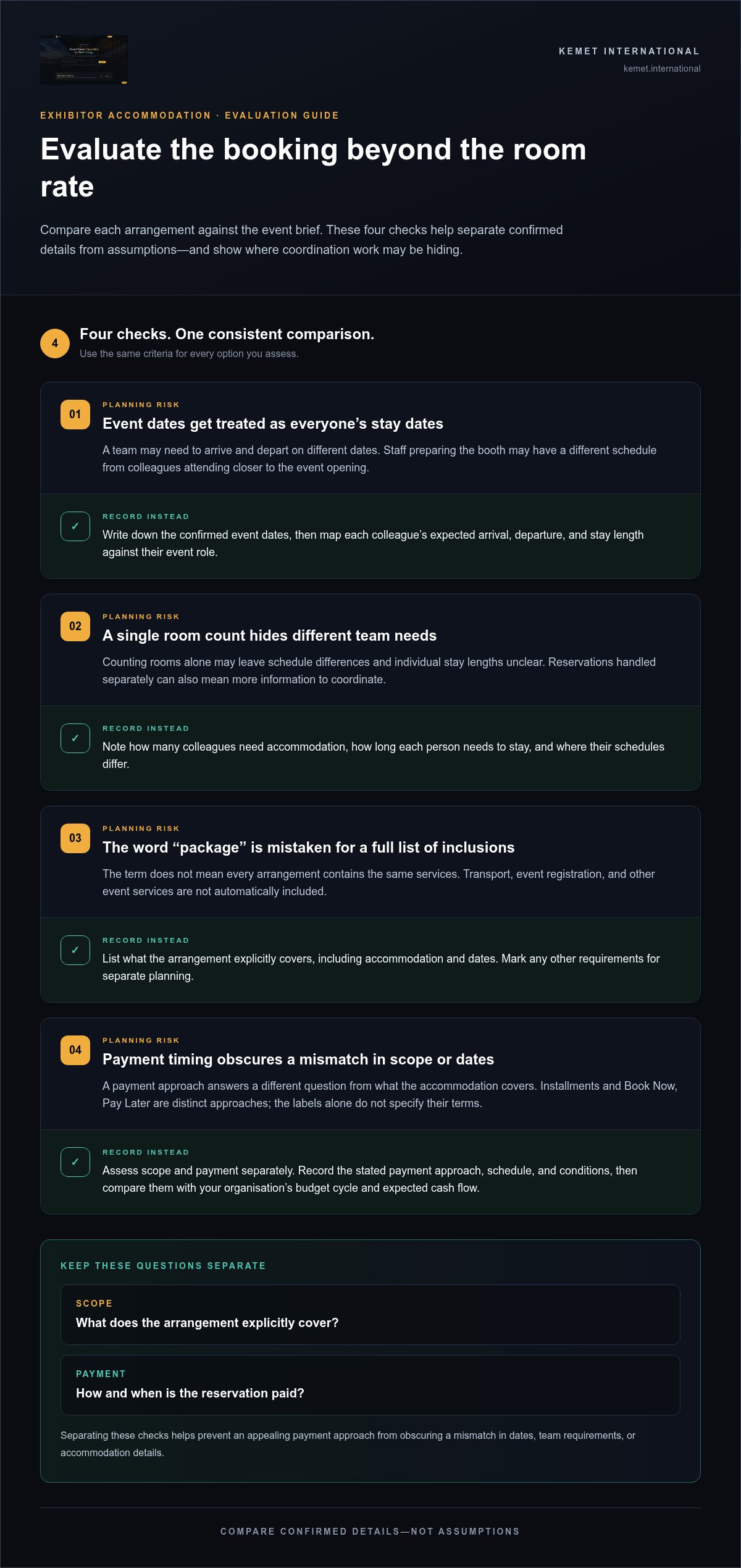
Assess each arrangement against the event brief, not against a generic idea of what a hotel package should contain. A clear comparison separates confirmed details from assumptions and shows whether the arrangement supports the team’s schedule, accommodation requirements, and payment planning. Record the same information for each option so the comparison is useful.
- Event dates: Record the confirmed event dates and the team’s expected arrival and departure dates.
- Team requirements: Note how many colleagues need accommodation, their stay lengths, and any differences in their schedules.
- Accommodation scope: Identify what the arrangement explicitly covers, including the accommodation being reserved and the dates involved.
- Payment structure: Record the stated payment approach, schedule, and conditions. Do not assume they are identical across arrangements.
Match the accommodation arrangement to event requirements
Start with the event calendar, then map each colleague’s expected stay against it. Staff preparing the booth may need different dates from colleagues attending only during the event. A single room count can hide those differences. The suitable arrangement depends on the actual brief: who needs accommodation, when they need it, and how their stays relate to their roles.
Next, separate the details that are stated from those your team is assuming. If an arrangement describes accommodation for specific dates, do not infer that other dates or event services are included. Keep a written record of what the package covers and which requirements need separate planning. This makes comparisons more reliable and prevents budgeting around assumed inclusions.
Assess scope and payment timing separately
Accommodation scope and payment structure answer different questions. Scope concerns what the arrangement covers; payment structure concerns how and when the reservation is paid. Review them as separate lines in your comparison. That distinction prevents an attractive payment approach from obscuring a mismatch in dates, team needs, or accommodation details.
Installments divide payment across more than one point, while Book Now, Pay Later is a distinct approach to payment timing. Neither label alone explains the applicable schedule or conditions. Compare the stated terms with your organisation’s budget cycle and expected cash flow. Do not assume that options using similar labels work identically.
Once event dates, team requirements, package scope, and payment conditions are recorded, use the same criteria to assess each option. This gives you a practical basis for choosing without relying on assumptions. Explore exhibitor hotel packages in light of the requirements you have documented.
How Do Exhibitor Hotel Booking Approaches Compare?
Three common routes are individual reservations made directly with hotels, official event hotel channels, and tailored exhibitor accommodation packages. They can differ in who coordinates the booking, how much control each traveller has, and which payment terms apply. Booking routes differ in coordination and terms, not just room selection. Compare the process as well as the accommodation.
| Booking approach | Booking control | Coordination needs | Payment approach | Information transparency |
|---|---|---|---|---|
| Individual direct bookings | Each traveller or organiser handles reservations with the hotel. | The team may need to collate separate confirmations and track changes. | Terms are attached to each reservation. | Details are available through the individual booking record. |
| Official event hotel channel | The booking follows the event channel’s process and listed properties. | Event-specific instructions can shape how attendees make reservations. | Payment terms depend on the event’s stated arrangement. | Terms are presented for that event and channel. |
| Tailored exhibitor accommodation package | The arrangement is shaped around exhibitor or team requirements. | Coordination can be planned around the team’s accommodation needs. | Options and conditions depend on the arrangement. | Assess the stated scope and terms against the event brief. |
Individual bookings versus coordinated exhibitor accommodation
Separate direct reservations can suit a small team whose members have different preferences or schedules. Each traveller can manage their own booking, while the organiser gathers dates, confirmation details, and updates into a shared record. A tailored arrangement uses the team’s requirements as its planning basis, which can change how coordination is handled. Neither route is automatically better. The fit depends on how much coordination the event requires and how the company wants reservation information organised.
Before deciding, identify who will maintain the reservation record, how schedule changes will be communicated, and whether the team needs a consolidated view of accommodation. These practical questions help show the work involved in each approach without assuming a particular booking method guarantees a specific outcome.
Official event hotels versus tailored packages
An official event hotel channel is an event-specific route, with its own booking instructions and terms. For example, SHOT Show has publicised event-linked discounts, no-fee benefits, and Pay Delay terms for its arrangement. Those details apply to that event’s offer, not to official hotel channels or exhibitor accommodation packages in general.
Tailored exhibitor hotel packages are structured around exhibitor or corporate team needs. Their scope and payment approach depend on the stated arrangement. Compare both routes using the same criteria: how reservations are coordinated, which requirements the arrangement addresses, and what payment conditions are specified. This keeps the decision grounded in your team’s operating needs rather than benefits that may apply only to another event.
How Can Teams Prepare an Exhibitor Hotel Package Brief?
A concise brief gives the team one reference point for accommodation decisions. It turns the event plan into usable booking information and makes gaps visible before reservations are coordinated. Record what is known, identify what may change, and assign responsibility for keeping the information current.
Build a concise accommodation brief
Start with the event information, then add each traveller’s requirements. A shared record helps colleagues work from the same dates and details instead of separate notes. Label confirmed information and estimates clearly, so a provisional schedule is not mistaken for a final requirement.
- Record the event brief. Enter the event name, confirmed dates, and the team’s relevant participation schedule. Note planning milestones that affect when colleagues need to arrive or depart.
- List the travellers. Add attendee names and identify who requires accommodation. Keep the list aligned with the team’s current event responsibilities.
- Map expected stay periods. Record each person’s anticipated arrival and departure dates. Label estimates as provisional and note who will update them.
- Define accommodation requirements. Capture the team’s stated needs and separate them from preferences that have not yet been agreed. This gives the accommodation plan a clear basis without turning assumptions into requirements.
- Assign booking responsibilities. Identify who coordinates the request, who maintains the shared record, and who needs access to reservation updates. Clear ownership reduces duplicate follow-up and conflicting versions of the plan.
A single brief supports consistent planning for exhibitor hotel packages because everyone working on the arrangement can refer to the same dates, traveller details, and requirements. Use it as the working record when comparing options and coordinating accommodation.
Coordinate reservations and payment records
Once reservation details are available, update the shared record with each booking’s status and relevant payment milestones. Make these fields visible to the colleagues responsible for travel coordination and event budgeting. Record only the payment information provided for the arrangement; do not infer a due date or condition from a general payment label.
Linking reservation records with the company’s event budget workflow helps the team review accommodation commitments alongside other planned event activity. The record can distinguish a reservation being arranged from one documented as booked. Keep confirmations, changes, and payment information together so colleagues can see the current status without piecing it together from separate email threads.
Kemet International’s AI travel technology supports accommodation management and reservation tracking. Explore tailored exhibitor hotel packages as part of your team’s accommodation planning.
How Kemet International Supports Exhibitor Accommodation Planning
Kemet International provides tailored hotel accommodation packages for trade show exhibitors and corporate event teams. You can assess the arrangement against the practical criteria in this guide: the event schedule, team requirements, accommodation scope, payment approach, and reservation management. This connects hotel planning with the wider work of preparing a team for an event.
Connect accommodation, payment options, and reservation management
Kemet’s accommodation packages are tailored to exhibitor and corporate team needs rather than presented as a fixed set of universal inclusions. Start with the event brief to frame the accommodation plan around team dates, traveller requirements, and reservation details.
Payment options include installments and Book Now, Pay Later reservations. These are distinct ways to plan payment timing, and the applicable details depend on the arrangement. Consider how the stated approach fits your organisation’s event budget workflow and cash-flow planning. Flexible timing can help teams assess accommodation commitments alongside other event expenses, but it should not be treated as a promise of savings.
Kemet’s proprietary AI travel technology supports accommodation management and reservation tracking. This helps keep reservation information organised as part of the event accommodation process. It complements package and payment planning, while accurate team requirements and dates remain essential.
Kemet also provides dedicated booth services. This is a related operational capability, not an assumed inclusion in a hotel package. Keep booth planning and accommodation planning visible as distinct workstreams so the team understands what each part of event preparation covers.
Review Kemet's exhibitor accommodation solutions as part of your planning process.
Take the next step with a clear event brief
Before progressing with accommodation planning, assemble a concise brief that brings the key information together. Include:
- Confirmed event dates and the expected stay period for each traveller.
- Attendee names, team requirements, and any differences in individual schedules.
- The accommodation needs the team has identified, separated from preferences or dates that may still change.
- The person responsible for coordinating reservations and keeping status information current.
- Payment milestones and the internal budget process they need to align with.
A clear brief gives the accommodation plan a consistent basis. Kemet tailors its exhibitor hotel packages to event and team requirements, so organised information helps define the planning context. Start with the event, document the team’s needs, and compare accommodation options against that brief.
Set Your Accommodation Plan in Motion
Turn the event schedule into a decision your team can act on. Use the brief to clarify who needs accommodation, which dates matter, and how payment timing fits your planning process. This gives you a practical basis for assessing exhibitor hotel packages against your team’s actual requirements.
Kemet International supports that planning with tailored accommodation for exhibitors and corporate event teams, installment and Book Now, Pay Later reservation options, and proprietary AI travel technology for accommodation management and reservation tracking. These services connect the reservation process with the operational details your team has assembled, while recognising that each package has its own stated scope.
Move forward with a clear brief and consistent criteria for evaluating your options. Explore Kemet International’s exhibitor hotel packages and take the next step toward a more coordinated event plan.
Frequently Asked Questions
Can small exhibitor teams use an exhibitor hotel package?
Yes. A small team can assess an exhibitor hotel package against its event schedule and accommodation requirements. If two colleagues arrive on different days, for example, the planning brief can record each stay separately rather than assume identical dates. The important factor is whether the arrangement suits the team’s needs, not its size. Review the stated scope and payment conditions when comparing it with individual reservations.
Can a hotel reservation be changed after it has been confirmed?
Possibly, but a change depends on the reservation’s terms and the hotel’s applicable conditions. If a traveller’s dates or details change, locate the confirmation and review the relevant amendment or cancellation provisions. Record the request, any response, and the updated confirmation in the team’s booking file. Do not treat a requested change as completed until the reservation record reflects the revised details.
What happens if an exhibitor's event dates change?
Reconcile the new event dates against each traveller’s confirmed stay before updating the accommodation plan. A revised event schedule may affect arrival or departure dates, so note which reservations need attention and who is responsible for each follow-up. Any change to a confirmed booking remains subject to its stated terms. Keep the original confirmation and subsequent updates together to preserve a clear record.
How should a company keep hotel booking records for expense reconciliation?
Use a consistent record for each reservation and connect it to the relevant event and traveller. Retain the booking confirmation, payment records, and the hotel’s invoice or receipt when provided. Record the reservation status and any changes so finance colleagues can distinguish an initial booking from its final details. Follow the company’s expense process and keep supporting documents together rather than relying on email threads alone.
Can accommodation planning be coordinated with booth services?
Yes. The team can coordinate both workstreams through a shared event plan. For example, the schedule can show when colleagues need to be available for booth-related work alongside their accommodation dates. Keep responsibilities and records distinct, however: booth services are a related capability, not an assumed part of a hotel package. Clear ownership for each workstream helps prevent accommodation tasks from being confused with booth arrangements.
Do exhibitors need to book every team member's room together?
No. A team may use one coordinated arrangement or maintain separate reservations, depending on its needs and the booking terms. Separate bookings can suit colleagues with different arrival dates or individual requirements, while a shared process can make it easier to maintain an overview. Whichever approach you use, keep a central record of who is staying, the dates, and the current reservation status.
What information should a company retain from a hotel booking confirmation?
Retain the traveller’s name, hotel details, stay dates, reservation reference, and the confirmation’s payment and change conditions. Keep later amendments with the original record, along with payment evidence and an invoice or receipt when available. This creates a traceable file for the traveller, event coordinator, and finance team. Limit shared access to colleagues who need the information for coordination or reconciliation.