
What should you decide before choosing a hotel for an exhibition? Start with what your team needs from the stay. Hotel booking for exhibitors works best when event dates, setup schedules, venue access and staff responsibilities shape the search from the outset.
The process can get complicated when team members need different room arrangements or stay dates, deadlines overlap, and payment terms are easy to miss. A defined workflow keeps those details visible and helps you make decisions in order.
This guide covers each stage, from turning event requirements into accommodation criteria to collecting room preferences, managing reservations and reviewing payment arrangements. It also explains how to keep booking details organised when plans change.
Kemet International provides tailored exhibitor hotel packages, with installment and Book Now, Pay Later options for hotel reservations. Its AI travel technology supports accommodation management, itinerary planning and reservation tracking. Use the steps below to connect these services to a structured booking process, make informed accommodation decisions and maintain a clear record of reservations.
Key Takeaways
- Start with event dates, access schedules and team size to define accommodation requirements before searching.
- Compare suitable options against the event brief, then record the reservation details in one place.
- Compare event-organised room blocks, individual reservations and tailored exhibitor packages by coordination, flexibility and record management.
- Keep traveller details, stay dates, confirmation records, payment status and booking ownership together in one checklist.
- Tailored packages and flexible payment options, including installments and Book Now, Pay Later, can support hotel booking for exhibitors.
Hotel Booking for Exhibitors Starts with the Event Requirements
A leisure stay usually centres on personal plans, while a general business trip is often organised around a meeting calendar. Exhibitor accommodation has a different operational purpose: it must support preparation, participation and close-down, as well as the people carrying out those duties. A Trade show can involve substantial company commitments, so plan around the work surrounding the event, not just the days visitors can attend.
An exhibitor hotel booking is accommodation planned around an event’s schedule and the team’s responsibilities, so each traveller has a suitable place to stay for their duties. Use that definition to build a brief before comparing options. It changes the first question from “Which hotel?” to “Who needs to be where, and when?”
What information belongs in an exhibitor accommodation brief?
Start with the event calendar, then add the people and room arrangements. Record arrival and departure windows, the required length of stay, and any dates when team members must be present before or after the public programme. List each traveller and note practical allocation needs, such as whether rooms are individual or shared. Include early starts, late exhibition-floor duties and other schedule constraints. This gives the booking process a usable baseline.
Separate requirements from preferences so you don’t reject a suitable option for the wrong reason. Requirements are conditions the plan must meet, such as dates needed for setup, a room for each designated traveller, or a stay that covers dismantling after the event. Preferences might include a particular room arrangement or added flexibility if duties change. Label each clearly. If a preference becomes essential for a team member, update the brief rather than leaving the distinction implicit.
How do event schedules affect hotel booking decisions?
Accommodation dates may need to begin before the event opens to the public. Exhibitors can have setup, preparation or other pre-event responsibilities, so plan arrival around the first required duty, not simply the first public day. The departure date should also account for post-event work. Leaving immediately after the final public session may not suit staff who need to finish exhibition-floor duties or close down.
Team members may need different stay plans. A setup crew could arrive earlier, while colleagues assigned to later event duties may not need the same arrival date. Record each person’s duty window alongside their accommodation dates. This avoids treating the whole team as one fixed block when responsibilities differ.
- Essential: event-related dates, required presence, traveller count and necessary room allocation.
- Preferred: room configuration or flexibility that would improve the stay but doesn’t determine whether the booking meets the brief.
Review the brief against the event schedule before choosing a booking route. This makes gaps visible early, such as an arrival that doesn’t cover setup or a stay that ends before a team member’s final duty. A clear specification gives you a practical test for the next decision: does the accommodation plan fit the event and the people responsible for delivering it?
How to Book a Hotel for an Exhibition in a Clear Sequence
Once the event brief is defined, use it to guide each booking decision. The sequence below takes you from that brief to a reservation the team can review and manage. Keep one current version of the requirements so travellers and the organiser aren’t working from conflicting details.
Move from a verified event brief to a suitable booking route, reviewed reservation conditions and a shared record of the confirmed stay.
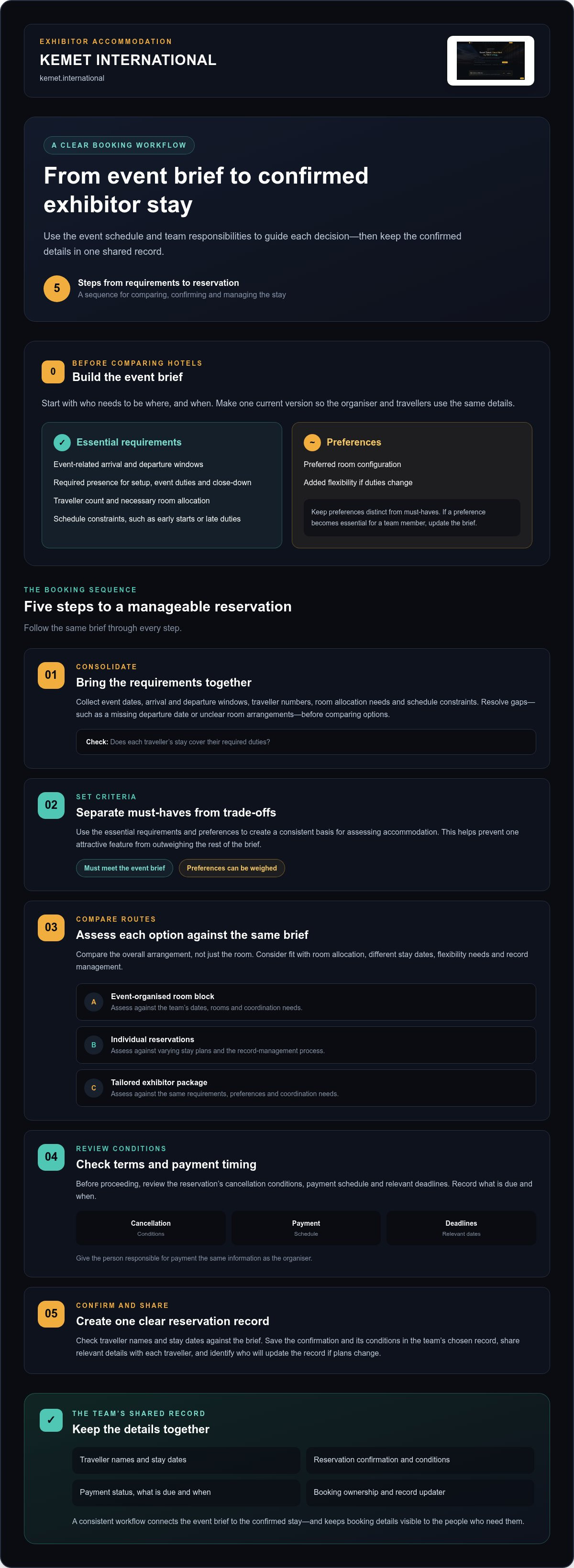
- Consolidate the requirements. Bring together event dates, arrival and departure windows, traveller numbers, room allocation needs and schedule constraints. Resolve gaps, such as a missing departure date or unclear room arrangements, before comparing options.
- Define the decision criteria. Separate requirements that must be met from preferences that can be traded off. This gives the organiser a consistent basis for assessing accommodation and prevents one attractive feature from outweighing the rest of the brief.
- Compare booking routes against the brief. Assess an event-organised room block, individual reservations or a tailored exhibitor package against the same criteria. Consider how each route fits the team’s room allocation, varying stay dates, flexibility needs and record-management process. Compare the whole arrangement, not just the room.
- Review reservation conditions and payment timing. Before proceeding, read the terms that apply to the reservation, including cancellation conditions, the payment schedule and relevant deadlines. Record what is due and when, and give the person responsible for payment the same information as the organiser.
- Confirm and share the booking details. Check traveller names and stay dates against the brief, then save the confirmation and its conditions in the team’s chosen record. Share relevant details with each traveller and identify who will update the record if plans change.
Consistency matters after booking. Give each traveller the confirmed dates, accommodation information and instructions relevant to their stay. Keep internal payment status visible to the responsible organiser, but distinguish it from information travellers need. Assign one owner to maintain the central record. Otherwise, a change recorded in one place may be missed elsewhere.
Store the confirmation, applicable terms and payment documentation together. These records help the team see what was reserved, which conditions apply and what still needs attention. Keep any documents needed for the organisation’s accounting process with the relevant reservation record, following its established procedures. This creates a clear reference for reviewing accommodation commitments after the event.
A structured workflow also makes payment planning easier to coordinate. Kemet International offers tailored exhibitor hotel packages, including installment and Book Now, Pay Later reservation options. Consider these as part of the payment review, and record the reservation details and responsibilities clearly. Explore tailored exhibitor hotel packages as an accommodation route for your event team.
Compare Hotel Booking Routes for Exhibitors Before Committing
After defining the team’s requirements, compare booking structures rather than treating every hotel search as equivalent. An event-organised room block, separate individual reservations and a tailored exhibitor package can differ in how rooms are coordinated, how changes are handled and where booking records sit. The Center for Exhibition Industry Research (CEIR) provides exhibition-industry research and insights. For accommodation planning, the practical task is to match the booking route to the event and the team’s operational needs.
Use this comparison as a starting point. It outlines coordination considerations, not guaranteed room availability, savings or reservation policies. Actual terms depend on the specific arrangement.
| Booking route | Coordination | Flexibility and room allocation | Record management |
|---|---|---|---|
| Event-organised room block | Accommodation options are presented through an event-linked arrangement. | Room choices and terms depend on the event’s stated arrangements. | Booking details may follow the event’s process, so the team should retain its own traveller-level record. |
| Individual reservations | Each traveller or organiser manages a separate reservation. | Each booking can reflect an individual’s dates and room needs, subject to its terms. | Details are spread across confirmations unless the organiser consolidates them. |
| Tailored exhibitor package | Accommodation is organised around exhibitor or corporate team requirements. | The package is tailored to the event team’s needs; reservation terms still apply. | A central coordination approach can help the organiser track team accommodation details. |
When might an event room block suit an exhibitor team?
An event room block can give people attending the same exhibition a shared, event-linked booking route. It may suit a team when the event publishes accommodation information for exhibitors and attendees. JCK’s event information is one example of an event-specific approach, with distinct booking information for those groups. Its arrangements illustrate one event, not a standard policy for all exhibitions. Review the stated dates, room process and terms to decide whether the block fits your team.
How do individual bookings and tailored packages differ?
Separate reservations give each traveller an individual booking to manage. This can suit different arrival dates, but the organiser must reconcile multiple confirmations, conditions and payment statuses. If your team has varied schedules, assign a record owner and keep the details in one tracker. This reduces the risk of relying on scattered messages or incomplete booking records.
A tailored exhibitor package uses exhibitor or corporate team needs as its organising context. Kemet International provides these packages for trade show exhibitors and corporate event teams. Consider this route when accommodation coordination is part of the booking brief, and review its reservation terms alongside the alternatives. No route is automatically best. Suitability depends on the event arrangements, team structure and conditions attached to the reservation.
Prepare a Hotel Booking Checklist for the Exhibitor Team
A shared record turns separate reservations into one manageable view of team accommodation. For hotel booking for exhibitors, it should show what has been confirmed, what payment action is pending and who owns the next update. Use an access-controlled document or system that the organiser can maintain and relevant team members can consult.
Build the checklist around one reservation entry per traveller or room allocation. Include:
- Traveller details: name and the team role or event responsibility needed to identify the booking.
- Stay information: arrival and departure dates, room details and any relevant allocation notes.
- Confirmation record: reference, booking status and a copy or location of the confirmation.
- Reservation conditions: cancellation terms and any amendment instructions that apply.
- Payment status: amount due if recorded in the reservation, payment timing, current status and the person responsible for the next action.
- Record owner: the organiser responsible for keeping the entry current and communicating changes.
Keep the confirmation, cancellation conditions and amendment details together, or clearly cross-reference where each is stored. This makes it easier to find the terms for a particular reservation without searching through email threads. Separate confirmed information from pending items, and date each update so the team can identify the current record.
What should the organiser verify in each reservation record?
Check the traveller’s name against the booking confirmation, then compare accommodation dates and room details with the team’s requirements. Capture the reference accurately and attach the applicable conditions or make them easy to locate. Record payment timing and status separately: a reservation can be confirmed while a payment action remains outstanding. Name the person handling amendments and specify how updates will reach affected travellers.
How can a team keep accommodation details aligned?
Maintain one current source of reservation information instead of allowing separate personal copies to become the working record. Give travellers the details relevant to their stay, while the organiser retains a consolidated view of team bookings, payment status and conditions. Limit access to people who need the information for their role. This supports coordination without circulating every record to everyone.
Set a straightforward update routine. After a booking, amendment or cancellation, the responsible owner updates the central entry and informs anyone affected. Before the event, review the list against confirmations and open payment actions. This can reveal mismatched dates, missing records or an unassigned responsibility.
For accommodation organised around exhibitor and corporate team needs, explore Kemet International’s tailored exhibitor hotel packages.
How Kemet International Supports Hotel Booking for Exhibitors
Kemet International provides tailored hotel packages for trade show exhibitors and corporate event teams. These packages offer an accommodation route organised around event participation and team requirements, rather than a general stay. They fit into the booking workflow after you have defined the brief and compared routes. Keep reservation details and conditions in the team’s records so the organiser can track accommodation alongside other event plans.
How can flexible hotel payments support event planning?
Hotel reservations can create payment obligations at different points in an event’s planning cycle. Kemet International offers installments and Book Now, Pay Later reservations as payment options for accommodation. Organisers can factor these into cash-flow planning by mapping reservation payment information against the wider event budget and noting the status in the booking record. This supports clearer coordination without assuming a particular schedule, eligibility, fee or payment condition.
Use the reservation’s actual payment information as the reference point. Record when payment is due, who is responsible for the action and whether it has been completed. This distinguishes a payment approach from its specific terms, which depend on the reservation. It also gives the organiser a clearer view of accommodation commitments as event costs are planned.
Where does AI travel technology fit into accommodation management?
Kemet International’s proprietary AI travel technology supports accommodation management, itinerary planning and reservation tracking. It can help streamline and automate accommodation management for corporate clients. It works alongside the event brief and reservation records, not in place of the organiser’s review of booking details, conditions and payment information.
For the team, the practical value is a more organised accommodation workflow. Set out the requirements and keep confirmed reservation information clear, then use the accommodation-management technology to support itinerary planning and reservation tracking. Human review remains important: check that each reservation aligns with the traveller’s needs and the event schedule, and update the record if a booking changes.
These services connect to the earlier booking steps. First, define the team’s accommodation requirements. Then select a suitable route, review reservation information and maintain an organised record. Tailored exhibitor packages provide an event-focused accommodation option. Installments and Book Now, Pay Later offer payment approaches to consider during budget planning. AI travel technology supports accommodation management. Together, they address different parts of the workflow while leaving the organiser responsible for understanding each reservation.
To apply this approach to your event accommodation planning, explore Kemet International’s tailored exhibitor hotel packages.
Set the Next Exhibition Stay in Motion
Put the booking workflow to work before accommodation decisions become scattered across messages and individual reservations. Start with the next event on your calendar: identify who owns the booking record, set a decision point for the team and schedule a review of reservation changes. A clear owner and review routine keep the process organised as event plans develop.
For teams planning hotel booking for exhibitors, Kemet International provides tailored hotel accommodation packages, installment and Book Now, Pay Later reservation options, and proprietary AI travel technology for accommodation management. These services support the accommodation process while your team maintains oversight of its requirements, reservation details and payment planning.
Explore hotel booking support for exhibitors and take the next step toward an organised accommodation plan for your event team. Start by bringing your event dates, traveller requirements and payment needs into one clear brief.
Frequently Asked Questions
How far in advance should exhibitors book a hotel?
Start planning once event dates and travel needs are clear, but there’s no universal booking deadline. Timing depends on event demand, team requirements and reservation terms. Before proceeding, review the booking conditions, including the dates covered and applicable change or cancellation provisions. This gives the organiser a basis for deciding when to book without assuming every exhibition follows the same timeline.
Can an exhibitor book hotel rooms for an entire team?
Yes, team accommodation can be arranged around shared event dates and individual traveller requirements. Each reservation still needs accurate traveller details, since bookings aren’t interchangeable just because they form part of one team plan. For example, a colleague arriving early for setup may need different dates from someone attending later. A central record helps the coordinator connect confirmations to travellers and track changes without relying on separate message threads.
What information is needed to book a hotel for a trade show?
Prepare event dates, traveller names, expected arrival and departure timing, room requirements and schedule constraints, such as an early setup call or a late shift on the exhibition floor. These details distinguish a standard event stay from individual travel patterns. For hotel booking for exhibitors, having the information ready also helps the organiser communicate consistent requirements when comparing accommodation options.
What happens if an exhibitor’s event dates change after booking?
If event dates change after a reservation, review that booking’s amendment and cancellation conditions before requesting a change. Follow the process that applies to the reservation, since available options and any charges depend on its terms. Then update the team’s shared record with the revised dates and status, and notify affected travellers. Keep the original confirmation with the updated information so the organiser can identify the current booking details.
Can hotel reservations for an exhibition be paid in installments?
Yes. Kemet International offers installments for hotel reservations. The terms for the booking govern the details, so don’t assume a particular schedule or eligibility rule. Include the applicable payment timing in the event budget and reservation record, then assign someone to monitor the payment action. This helps organisers account for accommodation commitments alongside other event spending while maintaining a clear view of the budget.
What does Book Now - Pay Later mean for exhibitor hotel reservations?
Book Now, Pay Later is a flexible payment option Kemet International offers for hotel reservations. The applicable terms govern each booking, so the label alone doesn’t establish a due date, approval process, fee or eligibility requirement. For planning, record the payment timing that applies to the reservation and include it in the event’s cash-flow plan. This keeps the accommodation commitment visible alongside other scheduled event costs.
Does an exhibitor hotel booking include booth services?
Kemet International provides both exhibitor hotel packages and dedicated booth services, but they’re distinct service areas. A hotel package shouldn’t be assumed to include booth support. Accommodation planning concerns where the team stays; booth services support exhibitors’ operational requirements on the exhibition floor. Plan each according to its own scope and budget, keeping lodging arrangements and floor-support responsibilities clear in the event plan.

