
A hotel that looks suitable on paper can still create problems if its timings, booking terms, or room arrangements do not fit your team’s needs. Knowing what to check before booking event hotels helps you match accommodation to the event schedule before comparing convenience or cost.
It is easy to focus on location and room rates first. But unclear cancellation deadlines, inclusions, or group reservation conditions can add work when plans change. Separate bookings can also make it harder to track who is staying where.
This checklist helps you assess an arrangement against the event schedule, attendee requirements, and your team’s booking process. Review arrival and departure timing, room needs, payment and cancellation conditions, and the details required to keep reservations organised. Tailored exhibitor hotel packages and reservation-tracking tools can support a more structured process for exhibitors and corporate event teams.
Key Takeaways
- Map accommodation dates to setup, event attendance, and breakdown duties before comparing hotel options.
- Use attendee roles, occupancy needs, and length of stay to assess whether room arrangements fit the team.
- Review cancellation, amendment, payment, and inclusion details in the reservation documents before approval.
- Use this guide to structure what to check before booking event hotels, then assign an owner to each outstanding decision.
- Consider how tailored exhibitor hotel packages and flexible reservation payments can support event-team planning.
What to Check Before Booking Event Hotels: Start with the Event's Operating Needs
Start with the work your team must complete, not with a shortlist of hotels. Accommodation needs to support a sequence of responsibilities: preparing a stand, attending sessions, meeting clients, and clearing equipment afterwards. The event’s purpose helps determine who needs a room, which nights matter, and what arrangements will keep each person available for their role.
This is the operational foundation of what to check before booking event hotels. Event management involves scheduling, site selection, budgeting, and coordinating with third parties, as outlined in the Event Management Overview. Apply the same coordination mindset to accommodation. A booking should reflect the event plan, rather than forcing the plan to adapt to assumptions made during a hotel search.
Before comparing arrangements, create a working record with event dates, responsibilities, traveller names or roles, and known requirements. Mark which details are fixed and which may change. This gives everyone a consistent basis for evaluating options and makes gaps visible before they lead to reservation changes.
Match accommodation dates to the event schedule
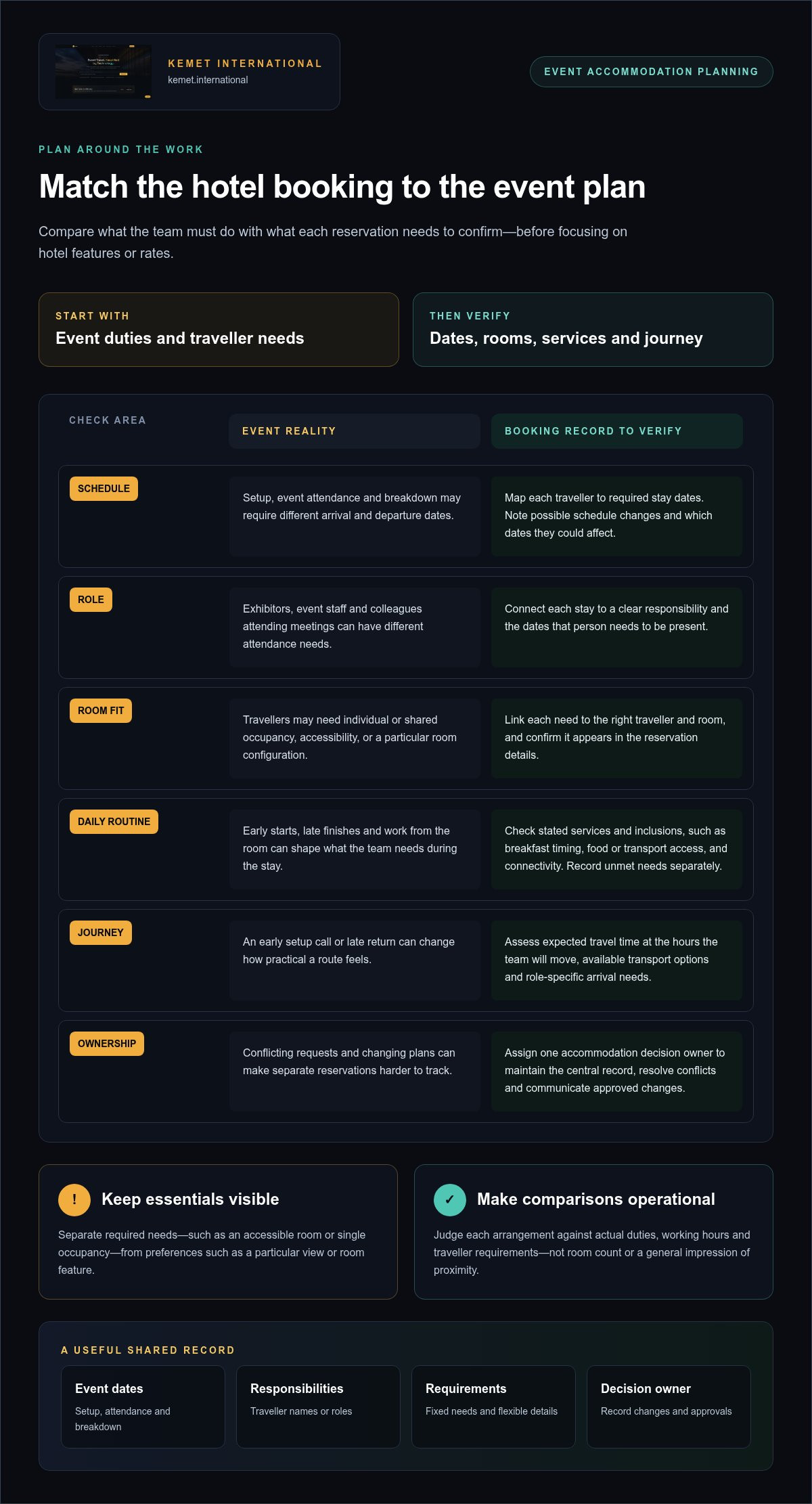
List each event day alongside setup, attendance, and breakdown duties. Then map travellers to the dates they need to be present. A stand team preparing before opening may need to arrive earlier than colleagues attending scheduled sessions only. Staff responsible for packing or handover may need to stay later. Record possible schedule changes, such as a revised setup time, and identify which stay dates they could affect.
Define who needs a room and what the team needs
Group travellers by responsibility, such as exhibitors, event staff, and colleagues attending meetings. For each person or role, note arrival timing, expected length of stay, occupancy needs, accessibility requirements, and any room configuration needed to support the work. Assign one accommodation decision owner to maintain the central record, resolve conflicting requests, and communicate approved changes.
Make requirements specific enough to guide a decision. “Close to the event” is less useful than recording when someone must be ready for setup or when they need to return to their room. Distinguish essentials from preferences, too. A required accessible room or single occupancy arrangement should not be buried among optional requests for a particular view or room feature.
Use this priority sequence before reviewing hotel arrangements:
- Schedule: Identify each traveller’s required arrival and departure dates, including setup and breakdown.
- Role: Connect each stay to a clear event responsibility and attendance requirement.
- Room needs: Record occupancy, accessibility, and configuration requirements by traveller.
- Ownership: Name the person responsible for maintaining the accommodation record and approving changes.
Finally, agree on the checks that will determine whether an arrangement is suitable. Arrival timing and room configuration may be top priorities for one team; another may focus on length of stay and coordinating several traveller groups. Set these priorities before comparing options. Tailored exhibitor hotel packages can help align accommodation planning with the needs of trade show and corporate event teams, while a shared record keeps decisions traceable.
Check Whether Event Hotel Rooms Fit Your Team's Practical Requirements
Once the event plan is set, assess each hotel arrangement against how the team will use it. Room count alone will not show whether colleagues can rest, prepare for their responsibilities, or reach event commitments without unnecessary friction. Compare the proposed room setup with each traveller’s occupancy needs and length of stay, then review services and inclusions against the daily schedule. This makes the comparison about operational fit, not just hotel features.
Review room types, occupancy, and accessibility
Match the room arrangement to the people who will use it. Check whether travellers need individual or shared occupancy, and record accessibility requirements before finalising allocations. Make sure each requirement appears in the reservation details and is linked to the right traveller and room. An internal spreadsheet alone will not ensure that a requirement is reflected in the booking. Keep preferences separate from essential needs so any trade-offs are clear.
Match hotel services to event-day routines
Assess stated services and inclusions against the hours your team will keep. An early start may make breakfast timing relevant, while a late finish can affect when a traveller needs access to food or transport. Review connectivity if staff need to coordinate or work from their rooms. If an operational need is not covered by the stated arrangement, record it as a separate decision rather than assuming it is included.
Consider the practical journey between the accommodation and event commitments, too. Assess expected travel time at the hours the team will move, available transport options, and whether someone’s role requires an earlier arrival than colleagues. A route that seems manageable during the day may be less suitable for an early setup call or a late return. Judge each stay against actual duties, not a general impression of proximity.
Use a comparison record to make differences visible across proposed arrangements:
- Room fit: Record room type, occupancy, length of stay, and accessibility requirements for each traveller.
- Daily routine: Note which stated services and inclusions support the team’s working hours.
- Journey: Compare the expected route and transport practicality for key event commitments.
- Open items: Flag requirements that need a separate arrangement or decision before approval.
Classify each item as essential, preferred, or unresolved. This helps the decision owner weigh trade-offs without overlooking a requirement that affects someone’s ability to do their job. It also supports accurate room allocation records when team members have different needs. For exhibitors and corporate event teams, tailored exhibitor accommodation can align hotel planning with team requirements. Use the same structured review to assess the proposed arrangement before committing.
Review Event Hotel Booking Terms, Payments, and Change Conditions
A room arrangement may fit the event plan and still cause problems if the reservation conditions are unclear. Review the documentation before approval, and identify who is responsible for booking, payment, and traveller updates. In a team reservation, a date change or room adjustment may affect several people, so agree on how changes will be handled before committing.
Understand cancellation, amendments, and reservation deadlines
Find the cancellation and amendment conditions for the specific reservation. Record the applicable deadlines, how changes to stay dates or room requirements are handled, and what steps the booking owner must take. Summarise these points for the approver in plain language, including conditions that could affect the team if event plans or traveller assignments change.
Read the terms as operational instructions, not just standard booking text. A cancellation deadline matters only if the team knows who monitors it and who is authorised to submit a change. Clarify how an individual traveller’s change is managed within a group arrangement, and whether changing one room could affect other reservations. Do not rely on assumptions from a previous booking, since conditions can vary between reservations.
Before seeking approval, capture the key conditions in a concise record:
- Deadlines: Note the applicable dates for cancellation, amendment, and any required approval.
- Change process: Record how date, occupancy, or traveller changes should be submitted.
- Responsibility: Identify who can authorise changes and who communicates them to travellers.
- Impact: Flag terms that could affect multiple rooms or the team’s reservation plan.
Check payment structure and booking inclusions
Map the payment schedule to your organisation’s approval workflow. Identify payment dates, accepted methods, and the person responsible for authorising each step. Compare the reservation documentation with the team’s agreed accommodation requirements, so the approver can see what is included and which needs remain separate. Keep payment responsibilities and booking conditions together in the review record.
Check each inclusion by name rather than assuming that a general description covers the team’s needs. If a service or item matters to the event-day routine, make sure it appears clearly in the reservation details. Note anything that requires a separate arrangement, internal approval, or traveller communication. This prevents the booking record from being mistaken for a complete account when some operational needs sit outside it.
Payment flexibility can also inform the decision. Installments or Book Now, Pay Later reservations may support cash-flow planning by aligning payment approaches with the organisation’s event budget and approval process. Review the applicable reservation payment details and determine how they fit internal controls. Do not assume a particular schedule or condition.
This is a central part of what to check before booking event hotels: the final reviewer should be able to see the reservation terms, payment responsibilities, listed inclusions, and change process in one place. A clear record gives the team a shared reference when plans shift and helps the approver decide with the material conditions in view.
Use a Final Event Hotel Booking Checklist Before You Commit
A final review should bring the event plan and reservation details into one approval record. The goal is not to repeat every earlier discussion. Verify that the agreed dates, room requirements, stated inclusions, payment conditions, and change deadlines match across the documents the team will use.
Use the same record to make unresolved decisions visible. Give each open item an owner and a decision deadline before approval. If a room allocation depends on a traveller’s confirmation, for example, name the person responsible for getting it and record how the reservation will be handled if the detail changes. This keeps assumptions from being treated as approved arrangements.
Build a clear pre-approval record
Prepare a concise summary that links the event schedule to the reservation details. Include confirmed stay dates, traveller and room requirements, stated inclusions, payment responsibilities, and relevant cancellation or amendment deadlines. Mark each item as agreed, pending, or requiring action. The approver can then see what is ready for commitment and what still needs a decision.
- Dates and rooms: Check that the reservation reflects the agreed stay dates, traveller assignments, occupancy, and room requirements.
- Inclusions: Compare the documented services and items with the team’s accommodation plan.
- Payment: Record the applicable payment conditions and the internal approval owner.
- Changes: Capture relevant deadlines, amendment conditions, and the person responsible for action.
- Open decisions: Assign an owner and decision deadline to every unresolved item.
Keep attendee and reservation information aligned
Maintain one current record as the reference point for accommodation decisions. Share relevant deadlines with colleagues coordinating travellers, and update the record when approved details change. Make changes traceable by noting what was updated and who owns any follow-up. This reduces the risk of one colleague using an outdated allocation while another shares different details with a traveller.
Before approval, compare the record with the reservation documentation one final time. Check names, dates, room assignments, and requirements that affect individual stays. Confirm that the approver can see the key conditions without searching through separate messages or files. If a material detail is unresolved, mark it clearly rather than letting it disappear into general notes.
This final control point turns what to check before booking event hotels into a repeatable review: verify the record, resolve or assign open items, and approve only against the documented arrangement. Kemet International’s exhibitor accommodation options can form part of planning around event requirements.
How Kemet International Supports Exhibitor Hotel Planning
A structured checklist makes accommodation decisions clearer. Kemet International provides tailored hotel packages for trade shows and corporate events, supporting planning around the practical needs of exhibitors and event teams. Organisers can consider responsibilities, stay dates, and traveller requirements together rather than treating every reservation as a separate task.
The aim is alignment, not complexity. Coordinating accommodation as part of event planning gives the team a more consistent view of its hotel arrangements. The checks in what to check before booking event hotels provide a useful starting point: define the requirements, review reservation conditions, and keep booking information organised.
Coordinate accommodation around exhibitor requirements
Exhibitors may have different schedules and room needs from other event-team members. Tailored hotel packages support planning around those requirements, including working dates and the composition of the travelling team. Bringing accommodation decisions into a structured plan can reduce fragmented coordination across individual reservations and keep responsibilities clear as arrangements are managed.
Use the checklist to shape the accommodation plan: identify who is travelling, what their event roles require, and how their stays fit the schedule. A shared view helps organisers connect room arrangements to event operations. Kemet International focuses on hotel accommodation for exhibitors and corporate event teams.
Plan payment and reservation tracking with greater structure
Payment approach is another part of the reservation decision. Installments and Book Now, Pay Later reservations give teams options to consider alongside their internal approval and event-planning workflows. The appropriate approach depends on the organisation’s planning requirements, so review the applicable payment details rather than assuming a particular schedule or condition.
Kemet International’s proprietary AI travel technology supports accommodation management and reservation tracking. Alongside clear responsibility for booking decisions, these tools support a more structured view of team accommodation. This helps organisers keep reservation information aligned as planning progresses, while retaining human oversight of the details and decisions.
For a final review, bring the team’s accommodation dates, traveller needs, payment approach, and reservation information together. Tailored packages, flexible payment options, and AI-driven accommodation tools each support a different part of the planning process. Together, they connect hotel arrangements with the operating needs of exhibitors and corporate event teams while leaving the organisation’s approval process in place.
Explore exhibitor hotel packages with Kemet International as part of planning accommodation around your event team’s requirements.
Make the Next Accommodation Decision Easier to Manage
Make this review a repeatable step in your event-planning process. Keep the approved accommodation record with the event plan, then use it as a starting point for future decisions. The team can refine its checklist around the requirements that matter most, giving approvers and coordinators a shared reference before reservations are committed.
The question of what to check before booking event hotels is also a prompt to assign clear ownership. Decide who maintains the accommodation record, who approves changes, and how updates reach affected travellers. A defined process supports continuity when responsibilities move between colleagues or event plans evolve.
For trade shows and corporate events, Kemet International provides tailored exhibitor hotel packages, flexible reservation payment options, and AI travel technology for accommodation management. Explore tailored exhibitor hotel packages with Kemet International to plan accommodation around your event team’s requirements.
Frequently Asked Questions
Is booking an event hotel the same as booking an event venue?
No. An event venue booking concerns the space used to host the event, while an event hotel booking concerns accommodation for attendees or staff. A hotel may offer both, but reserving guest rooms does not automatically reserve meeting or exhibition space. Treat them as separate decisions with distinct requirements, documentation, approvals, and owners, even when the same organisation is involved in both.
What is a rooming list for an event hotel booking?
A rooming list is a working record that matches each traveller with their stay dates and room assignment. Organisers may also use it to track arrival details or requests relevant to allocation. For example, it can show which colleagues share a reservation period and which have different departure dates. Limit access to people coordinating accommodation, and update the list when assignments change.
Can attendees book their own rooms for a corporate event?
Yes, attendees can book individually if that approach fits the organisation’s process. It can give travellers more control over their arrangements, but it may leave the coordinator with separate confirmations, deadlines, and booking records to reconcile. Set a consistent method for reporting booking status and required details. For example, travellers can record their confirmation reference and stay dates in the team’s central tracker.
Do hotel booking confirmations include every attendee's name?
Not always. An individual confirmation may show only the person who made that reservation, while a group booking may use separate documentation for room assignments. Check which names appear on each confirmation and maintain a separate traveller-to-reservation record where needed. A coordinator can then match every attendee to the relevant booking reference and identify missing or duplicated assignments before sharing final travel details.
Can I arrange event hotel accommodation before the attendee list is final?
Yes, planning can begin with an estimated traveller count while names are still being confirmed. Keep the estimate distinct from confirmed reservations, and record which decisions depend on the final list. For example, identify whether room allocations or stay dates may need revision as participants are added or removed. Before committing, understand how the reservation handles changes and set an internal date to reconcile the list.
What records should employees keep for event hotel reimbursement?
Employees should retain the booking confirmation, itemised invoice or receipt, proof of payment, and any approval record required by their organisation. Keep a note of the event’s business purpose and save correspondence that documents a change to the original stay. Follow the employer’s reimbursement process, since required records can vary. Store the documents together so the expense reviewer can connect the charge to the approved trip.
