
What makes Spain trade fair accommodation challenging is often not finding a room, but coordinating the stay around the work. Event dates, setup and breakdown duties, team schedules, room requirements and payment timing all affect whether a booking fits.
It’s easy to focus first on venue access and room availability. But accommodation planning works better as part of exhibitor logistics, not as a standalone room search. A clear process helps teams match stays to work schedules, coordinate bookings and plan accommodation payments alongside other event costs.
This guide sets out a practical framework for arranging trade fair stays in Spain. You’ll learn how to map accommodation needs to event dates and working schedules, coordinate requirements across a team and manage booking records and payment planning. It also explains how tailored exhibitor hotel packages, installment options and Book Now, Pay Later reservations can support planning, with AI travel technology helping streamline accommodation management. The goal is a booking workflow that reflects the demands of exhibiting, rather than treating the trip as leisure travel.
Key Takeaways
- Plan Spain trade fair accommodation around event dates, team attendance and working schedules, not room searches alone.
- Use setup and breakdown timings to shape arrival and departure plans, then estimate the room nights the team needs.
- Compare individual bookings with coordinated exhibitor arrangements to see how each handles rooming, changes and payment workflows.
- Keep booking status, assigned owners and outstanding changes in one shared record to make team coordination easier.
- Consider how tailored exhibitor hotel packages and flexible reservation payment options can support accommodation planning and event cash flow.
What Spain Trade Fair Accommodation Needs to Solve for Exhibitors
A trade fair brings businesses together to present products, build professional relationships and meet potential customers. For a broader overview of the format, see What is a Trade Show? For exhibitors, participation involves more than attending the event. Accommodation needs to support the people and schedules that keep the stand operational.
Exhibitor accommodation is lodging planned as an operational part of event participation, aligned with team schedules, work requirements and coordination needs. That makes Spain trade fair accommodation different from a standard hotel search. A room may be available for the event dates but still not fit the team’s arrival pattern, working hours or practical requirements.
How exhibitor travel differs from a standard hotel search
Leisure stays often follow a simple pattern: arrive, stay for the planned dates, then depart. Exhibitor schedules can involve distinct phases, each with different accommodation needs:
- Setup: Some team members may need to arrive before the fair opens to prepare the stand, arrange display materials or complete other operational tasks.
- Event days: Staff may attend on different days or work staggered shifts. The whole team may not need the same check-in and check-out dates.
- Breakdown: Dismantling and packing can extend the working day. Plan departures around the actual finish time, not only the fair’s final public hours.
Team size and arrival patterns also shape the room plan. A group arriving together may need a different approach from colleagues travelling separately or joining for specific days. Record who needs accommodation, which dates apply to each person and any work-related requirements that affect the stay. This gives the team a clearer basis for planning its daily schedule before the event begins.
Which details should shape the accommodation plan?
Event dates provide the starting point, not the full booking requirement. Map the work schedule against the calendar, then identify where individual attendance or operational duties extend the stay. Venue access is another planning factor: consider how the accommodation location fits the team’s journey to the event and daily timetable, without assuming every attendee needs the same arrangement.
Build the plan around these details:
- Official event dates and any separate setup or breakdown days.
- Team attendance days, including who needs to be present at each stage.
- Arrival windows and departure needs, including differences between team members.
- Rooming requirements, such as how many people need accommodation on each night.
- Venue access considerations and the expected daily travel routine.
Label each item as confirmed or estimated. Use confirmed details to guide the current plan, and keep estimates visible so they can be revised as staffing and schedules develop. For example, record an expected arrival window separately from a fixed arrival time. This gives the accommodation plan a reliable basis without treating early assumptions as final.
Matching Spain Trade Fair Stays to Event Schedules
Turn the published event timetable into a separate travel and accommodation schedule before arranging rooms. The fair’s opening and closing dates show when the event runs, but not necessarily when each exhibitor needs to be present. For Spain trade fair accommodation, map work commitments to individual arrival and departure dates, then use the record to estimate room nights.
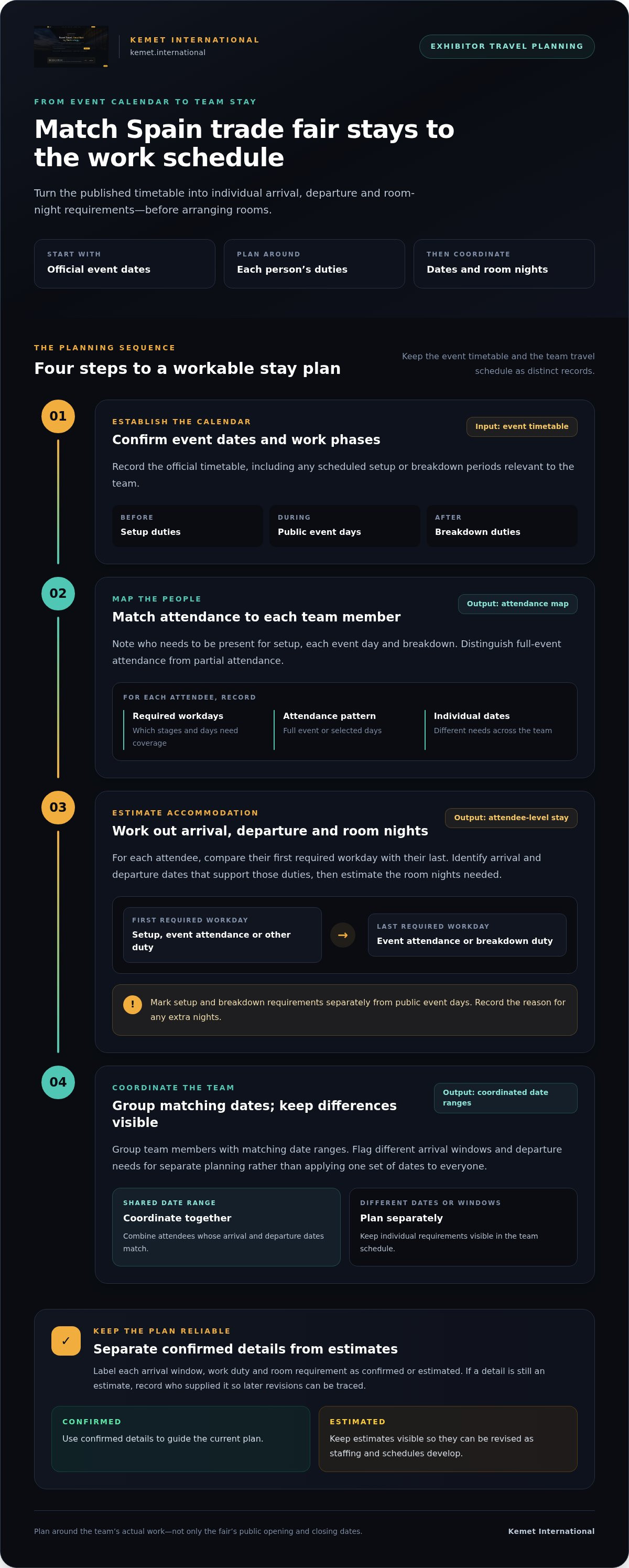
Confirm the event dates, map each person’s attendance, estimate the required room nights, then coordinate arrivals and departures. This sequence turns the organiser’s calendar into a plan based on the team’s actual requirements.
- Confirm event dates. Record the official timetable, including any scheduled setup or breakdown periods relevant to your team.
- Map attendance. Note who needs to be present for setup, each event day and breakdown. Distinguish full-event attendance from partial attendance.
- Estimate room nights. For each attendee, compare their first required workday with their last, then identify the arrival and departure dates that support those duties.
- Coordinate arrivals. Group team members with matching date ranges and flag different arrival windows or departure needs for separate planning.
Keep the event timetable and team travel schedule as distinct records. For example, the fair may open on one date while the stand team needs to arrive earlier to prepare. Someone finishing breakdown may need a later departure than colleagues whose duties end with the public programme. These differences affect room-night estimates and help prevent one set of dates being applied to everyone. Official Tourism Information for Spain provides broader destination information for planning practical travel details around the business schedule.
Turn the event timetable into room-night requirements
Create a line for each attendee, with their event attendance dates, planned arrival and departure dates, and the reason for any extra nights. Mark setup and breakdown requirements separately from public event days. If an arrival window or work duty is still an estimate, label it and record who supplied the information. That makes later revisions traceable instead of silently changing the room plan.
Coordinate shared requirements across an exhibitor team
Keep attendee names, room needs and date ranges in one working record. Compare entries to identify overlapping stays and individual exceptions, such as a colleague joining for selected days. Assign an owner to maintain the record and use one current version for updates. This reduces conflicting edits and gives the accommodation coordinator a consistent view of requirements.
Once the room-night plan is structured, Kemet’s tailored exhibitor hotel packages can support accommodation planning around team requirements, connecting the event schedule with coordinated booking.
Compare Spain Trade Fair Accommodation by Coordination and Payment Needs
The right booking approach depends on how stable the attendee group is and how much coordination the trip requires. Individual reservations can suit a small team with fixed dates and straightforward room needs. Coordinated exhibitor hotel arrangements can provide a shared structure when rooming details, schedules or booking administration span several people. Neither approach is always better. Compare the work each creates for your team.
Use these differences to identify where the main coordination and payment responsibilities will sit:
| Planning factor | Individual bookings | Coordinated exhibitor hotel arrangements |
|---|---|---|
| Rooming coordination | Each attendee manages their own reservation. The organiser needs a separate way to track who has booked and for which dates. | Room requirements can be considered together, making shared dates and individual differences easier to oversee. |
| Administration | Booking tasks are distributed among attendees, with a team owner consolidating status if needed. | A designated coordinator can maintain a common view of accommodation requirements and reservation progress. |
| Schedule changes | Updates may need to be communicated and managed across separate reservations. | Changes can be recorded against the shared rooming plan, with the responsible owner tracking what has changed. |
| Payment workflow | Payment administration may sit with each traveller or follow the organisation’s individual expense process. | Payment planning can be considered alongside the team’s accommodation requirements and event budget. |
Individual bookings or coordinated team accommodation?
Independent reservations may be practical when the attendee group is small, dates are settled and each person can manage their own booking. A coordinated approach is useful when one organiser needs oversight of multiple room requirements, shared dates or changes. For Spain trade fair accommodation, assess how many separate decisions and updates the team must manage, not only the initial booking task.
How payment structure fits event planning
Accommodation payments are one part of event cash-flow planning. Kemet provides installments and Book Now, Pay Later options for hotel reservations. Consider these options alongside other event commitments when mapping expected payments and internal budget responsibilities. They don’t remove the need to track reservation costs and payment obligations in the event budget.
Keep the comparison operational: identify who coordinates rooms, who administers changes and how payment timing fits the organisation’s planning cycle. Kemet’s tailored exhibitor hotel packages bring accommodation planning into the context of trade show and corporate event team requirements. The selected payment option can also be factored into the broader budget workflow.
Use This Checklist to Plan Trade Fair Accommodation Across Spain
A reliable accommodation plan needs more than a list of names and dates. It needs a clear brief, an owner for updates and a record that distinguishes confirmed details from working assumptions. Use this checklist to keep Spain trade fair accommodation aligned with the event schedule as team requirements develop.
Create a usable accommodation brief
Start with the event timetable and build a concise brief that the accommodation coordinator can maintain. Gather attendee numbers, room requirements and date ranges, then assign one owner to consolidate information. Keep unresolved details visible: a possible extra night or unconfirmed attendee should remain an estimate, not a settled requirement.
- Event schedule: Record the event dates and any relevant setup or breakdown commitments.
- Attendee count: List confirmed attendees separately from people whose participation is still being decided.
- Required dates: Capture each attendee’s expected arrival and departure dates, including differences within the team.
- Rooming needs: Note each person’s room requirements and any preferences that affect the plan.
- Schedule assumptions: Mark estimated timings or attendance days, and record who owns the next update.
- Venue access: Include the team’s practical access needs as a planning consideration, without assuming everyone has the same daily routine.
The brief should answer a simple question: what does the team currently need, and which details could still change?
Maintain a clear booking record
Once planning moves into reservations, use a shared record to connect each booking with the attendee and current requirement. Keep the format straightforward so an authorised team member can see what is booked, what remains outstanding and who is responsible for the next action.
- Booking status: Show whether the reservation is planned, in progress or recorded as booked.
- Attendee assignment: Link each reservation to the person or room requirement it serves.
- Booking information: Record relevant reservation details in the team’s approved system.
- Assigned owner: Name the person responsible for maintaining each record or resolving an outstanding item.
- Changes log: Note what changed, when it changed and who updated the information.
Review the record whenever the attendee list or event timetable changes. Compare updated work dates with current reservation dates, flag any mismatch and assign it to the owner. Before final coordination, reconcile the latest brief with the booking record so estimates, changes and confirmed reservations are not confused.
For accommodation planning shaped around exhibitor requirements, see Kemet’s exhibitor hotel packages.
How Kemet Supports Spain Trade Fair Accommodation Planning
Once event dates, attendee requirements and booking responsibilities are clear, choose an accommodation approach that fits the exhibitor’s work. Kemet International provides tailored exhibitor hotel packages for trade shows and corporate events. The planning focus is on the team’s requirements: who needs accommodation, which dates apply and how the stay relates to event participation.
Accommodation packages designed for exhibitor requirements
A tailored package gives exhibitors an accommodation option shaped around the needs of the event and its team. Use the rooming plan and schedule assumptions from the planning stage to define the requirements behind the stay. This keeps accommodation planning connected to work commitments rather than treating every attendee as if they shared identical dates and needs. It also gives the team a clearer basis for coordinating hotel reservations.
For example, an exhibitor group may include staff attending throughout the event alongside colleagues whose duties cover only specific stages. A team-focused accommodation plan can account for those different requirements, rooming information and schedule changes. Kemet International’s exhibitor hotel packages are designed for trade shows and corporate events, linking the stay to the practical needs of participation.
Technology and payment options in the booking workflow
Kemet International’s proprietary AI travel technology supports accommodation management, including itinerary planning and reservation tracking. It helps bring room requirements and event schedules into a more streamlined booking workflow, while accurate team information remains essential to planning.
Payment planning also belongs in the workflow. Kemet International provides installments and Book Now, Pay Later options for hotel reservations. Include the selected reservation option in the organisation’s event budget and cash-flow planning alongside other event commitments. The payment schedule and terms should be reflected in the organisation’s financial workflow.
Accommodation remains the central requirement, but exhibitors may also need support on the event floor. Kemet International provides dedicated booth services to support event-floor operations alongside accommodation planning. Include these needs in the wider event plan while keeping booth support distinct from the hotel booking.
With tailored hotel packages, accommodation management technology and flexible reservation payment options, Kemet International supports a more organised approach to Spain trade fair accommodation. Plan your exhibitor accommodation with Kemet International.
Move Your Exhibitor Accommodation Plan Forward
Turn the planning work into an operating record with a clear owner and review point. As exhibitor responsibilities develop, route accommodation updates through that record rather than relying on separate messages or memory. This gives the team a consistent basis for decisions and makes the next action visible.
Treat Spain trade fair accommodation as part of event readiness. Assign responsibility, keep decisions current and align the booking workflow with your organisation’s approval and payment processes. Set a review point before each major internal milestone so changes can be addressed in an orderly way.
A defined process helps accommodation planning progress alongside the wider event plan. Plan your Spain trade fair accommodation with Kemet and coordinate your exhibitor stay.
Frequently Asked Questions
Is trade fair accommodation in Spain different from a standard hotel booking?
Yes. Spain trade fair accommodation needs to account for work obligations that may fall outside the event’s public opening hours. For example, a stand lead may need to be present for preparation while a sales colleague attends only on scheduled fair days. Plan each person’s stay around their responsibilities, then check that the combined arrangement supports the team rather than relying on one set of dates for everyone.
How far ahead should exhibitors plan accommodation for a trade fair in Spain?
Start once the event dates and likely attendee group are clear enough to form a working plan. There isn’t one lead time that fits every fair. The right point depends on event demand, team size and how stable the schedule is. If staffing is still developing, create a provisional room requirement and set a review date rather than waiting until every detail is final.
Can an exhibitor team coordinate hotel accommodation when people have different schedules?
Yes. Track each person’s dates separately, even when the team shares one accommodation plan. For example, distinguish a staff member covering the full event from a colleague joining for one work phase. Give the record a clear version date and name its owner, so team members can identify current information before making decisions or submitting updates.
How much does trade fair accommodation in Spain cost?
There’s no single price for trade fair stays across Spain. The cost depends on event timing, room requirements, length of stay and the conditions of a particular reservation. For budgeting, first define expected room nights and attendee numbers, then use the reservation details in your cost forecast. Keep estimates distinct from confirmed amounts and include accommodation payments in the wider event budget.
What should an exhibitor include in a hotel rooming list?
Include each traveller’s name, required dates, room requirements and current booking status. Add a field for unresolved details, such as a departure date awaiting approval, and identify who will update it. Avoid notes that could be mistaken for confirmed instructions. Before sharing the list, check that each entry corresponds to an attendee and remove duplicate or superseded rows.
What happens if an exhibitor’s event schedule changes after accommodation planning starts?
Update the planning record promptly and identify the affected travellers and dates. Review the conditions attached to each relevant reservation before making a change, since the process can vary by booking. Record the decision and its owner so the team can distinguish a requested change from a completed update. Keep the event timetable and accommodation record aligned as revised work dates are approved.


